Volume and Not Weight Rule out Hydrogen Combustion for Passenger Cars, Reveals IDTechEx Research
Volume and Not Weight Rule out Hydrogen Combustion for Passenger Cars, Reveals IDTechEx Research
BOSTON--(BUSINESS WIRE)--Hydrogen internal combustion engines (H2ICE) promise (almost) zero emissions transport without relying on expensive, slow-to-recharge batteries. As hydrogen is a carbon-neutral fuel, H2ICE offers an opportunity to retain the combustion engine in an increasingly zero-emissions world. OEMs and suppliers can apply minor modifications to existing engine and vehicle production lines and produce carbon-neutral vehicles that retain many characteristics of existing ICEs.
So, does the hydrogen combustion engine offer a viable route to continuing ICE vehicle production? According to IDTechEx’s new “Hydrogen Internal Combustion Engines 2025-2045: Applications, Technologies, Market Status and Forecasts” report, the answer is, at least for cars, no. But why?
Hydrogen is the most abundant element in the universe, and is also the lightest. When combusted in the presence of oxygen, hydrogen releases a huge amount of energy - around 39.3kWh per kg. In comparison, a kilogram of diesel contains 12.6kWh. This might suggest that hydrogen is a wonder fuel, able to store huge quantities of energy and enable hydrogen-powered vehicles to travel enormous distances without needing large storage tanks. This is only half true, and weight is only part of the problem. The big issue is volume.
While hydrogen has a high gravimetric energy density, it has a very low volumetric energy density, about 3,000 times less than diesel at atmospheric pressure. To get useful amounts of energy, hydrogen must be stored as a compressed gas, typically at 350- or 700-times atmospheric pressure. Even in its most dense form (liquid), hydrogen contains just 26% of the energy per volume as diesel.
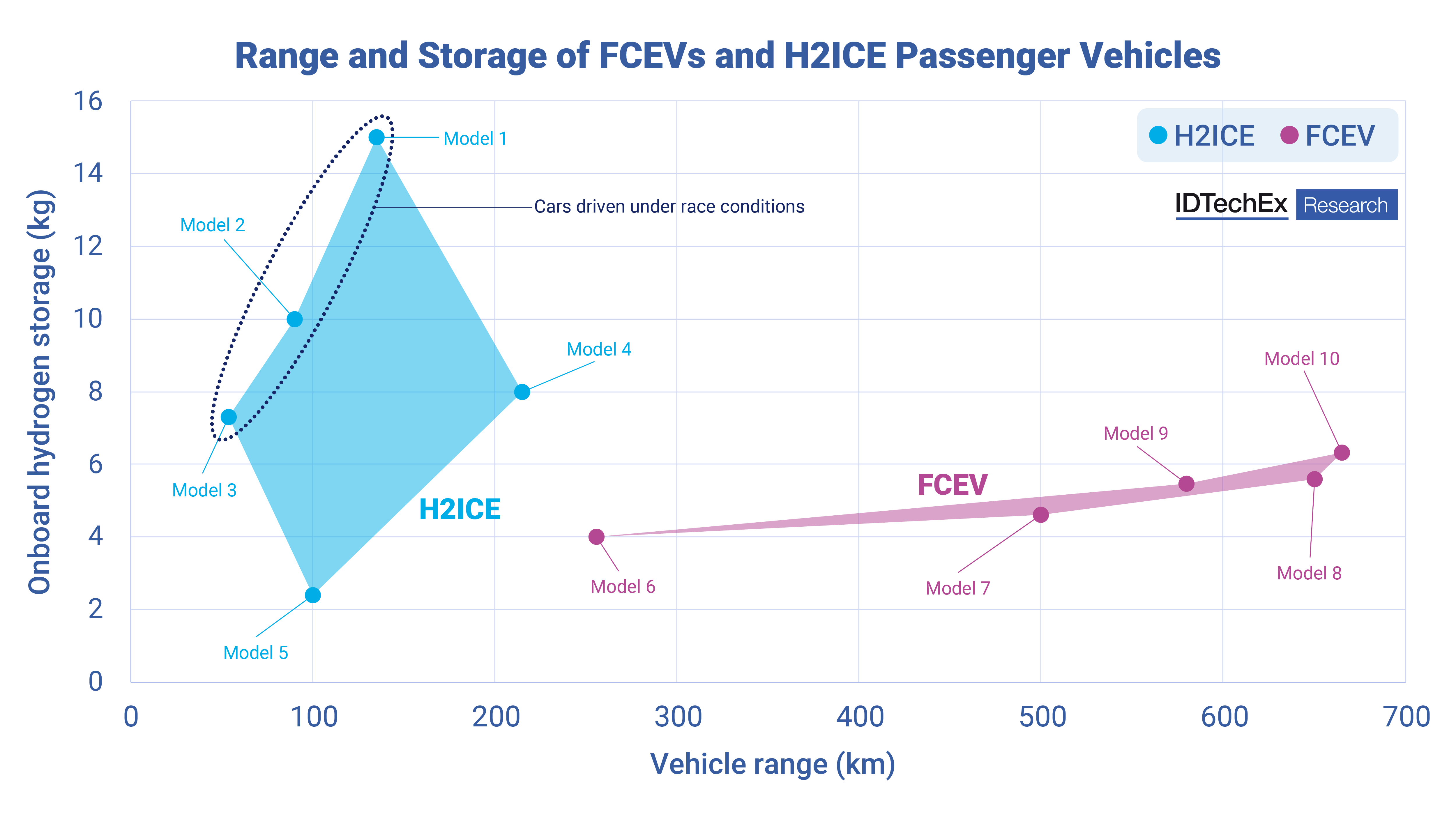
The driveable range also factors in the energy efficiency of a vehicle. This is where H2ICE falters compared with its hydrogen counterpart, the fuel cell electric vehicle (FCEV), which travel further on the same amount of hydrogen than an H2ICE vehicle.
IDTechEx has analyzed the real-world performance of various H2ICE and FCEV vehicles to assess fuel consumption, and the results clearly show that FCEVs are more fuel-efficient. For a passenger car to run on hydrogen combustion and achieve a range comparable to a petrol/diesel ICE, it would need an enormous storage vessel – a tank 3.5x larger would be required to contain the same energy content.
IDTechEx’s report explores some of the sectors where these challenges are less pronounced, and the case for H2ICE is much stronger. For passenger cars, however, the future seems set to be electric.
To find out more about the new IDTechEx report, please visit www.IDTechEx.com/H2ICE. Downloadable sample pages are available.
For the full portfolio of hydrogen market research available from IDTechEx, please see www.IDTechEx.com/Research/Hydrogen.
About IDTechEx
IDTechEx provides trusted independent research on emerging technologies and their markets. For more information, contact research@IDTechEx.com or visit www.IDTechEx.com.
Contacts
Charlotte Martin
Subscriptions Marketing Manager
press@IDTechEx.com
+44(0)1223 812300