Snowflake Unveils New Large Language Model to Extract Deeper Insights from Documents, While Continuing to Advance Platform Speed and Performance
Snowflake Unveils New Large Language Model to Extract Deeper Insights from Documents, While Continuing to Advance Platform Speed and Performance
- Document AI (private preview) leverages Snowflake’s first-party large language model to unlock deeper insights from documents and extract value with increased speed, accuracy, and simplicity
- Customers like Booking.com are using Snowflake Iceberg Tables (private preview soon) to extend Snowflake's performance and governance to data stored in open formats
- New Snowflake Performance Index shows an improvement of 15 percent in query duration for customers' recurring workloads since Snowflake began tracking this metric1
LAS VEGAS--(BUSINESS WIRE)--Snowflake (NYSE: SNOW), the Data Cloud company, today announced at its annual user conference, Snowflake Summit 2023, new advancements to its single, unified platform that make it easier for organizations to get value from all of their data, while continuing to deliver improved performance for customers’ most critical workloads. With new innovations like Document AI (private preview), Snowflake is launching a new large language model (LLM) built from Applica's pioneering generative AI technology to help customers understand documents and put their unstructured data to work. Snowflake is also unveiling updates to Iceberg Tables (private preview soon) to further eliminate data silos and allow organizations to use open table formats with fast performance and enterprise-grade governance for both data in Snowflake’s catalog and data managed by another catalog. In addition, the new Snowflake Performance Index (SPI) provides increased transparency and metrics around Snowflake’s ongoing performance improvements, revealing that query duration has improved by 15 percent1 for stable customer workloads since Snowflake began tracking this metric over the last eight months — reinforcing how Snowflake continues to advance price per performance for customers.
One example of a customer embracing Snowflake’s single platform and continued innovation is Fidelity Investments. As one of the largest financial institutions serving over 40 million customers daily, key stakeholders across Fidelity’s 68,000-plus global associates rely on Snowflake’s unified data platform to drive impact.
“It’s every CIO’s dream to have all of your organization’s data in one place, and the Data Cloud actually makes that possible. It’s imperative that key stakeholders across our organization have visibility into the same single source of data truth to seamlessly answer questions and solve problems faster,” said Mihir Shah, CIO and Enterprise Head of Data Architecture and Engineering, Fidelity Investments. “The Data Cloud helps us eliminate silos and deliver governed access to data across key stakeholders, enabling us to continuously innovate at scale, drive increased efficiency, and ultimately create more value for our customers.”
Snowflake Brings the Power of LLMs to the Data Cloud
Over the next five years, over 90 percent of the world's data will be unstructured in the form of documents, images, video, audio, and more according to IDC2. This massive volume of unstructured data is routinely stored by organizations, however gaining valuable insight from it has historically required manual, error-prone processes and limited expert skillsets. Building on Snowflake’s support for unstructured data, Snowflake’s built-in Document AI will make it effortless for organizations to understand and extract value from documents using natural language processing.
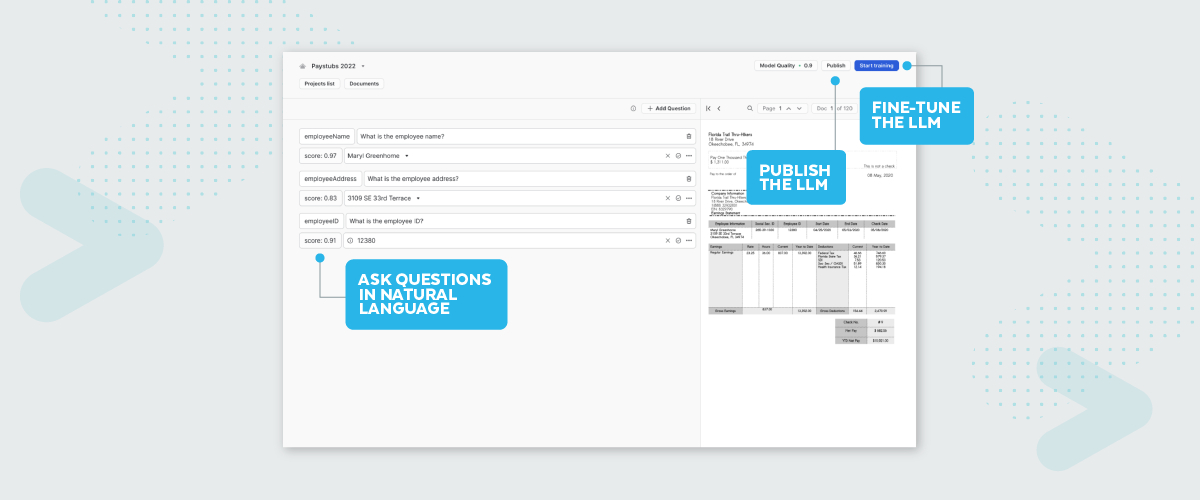
Document AI stems from Snowflake's acquisition of Applica (Sept. 2022) and leverages its purpose-built, multimodal LLM. By integrating this model within Snowflake’s platform, organizations will be able to easily extract content like invoice amounts or contractual terms from documents and fine-tune results using a visual interface and natural language. Customers are using Document AI to help their teams be smarter about their businesses, and enhance user productivity in secure and scalable ways. Snowflake is starting with Document AI and plans to expand these capabilities to more types of unstructured data.
Snowflake Extends Performance and Governance to More Data with Iceberg Tables
As Apache Iceberg continues to grow in popularity as the industry standard for open table formats, Snowflake is making it easier for enterprises to extend the value of the Data Cloud to Iceberg data. With Iceberg Tables, organizations can work with data in their own storage in the Apache Iceberg format, whether that data is managed by Snowflake or managed externally, while still benefiting from Snowflake’s ease of use, performance, and unified governance. This simplifies data management by eliminating the need for organizations to move or copy data between systems, all the while increasing flexibility and reducing costs. In addition, Apache Iceberg’s growing ecosystem of diverse adopters, contributors, and commercial offerings future-proofs storage, preventing vendor lock-in and frequent migrations. Customers like Booking.com are leveraging Iceberg Tables today to bring the power of the Data Cloud to all of their data.
Snowflake Improves Query Duration for Stable Customer Workloads by 15 Percent Since It Began Tracking This Metric
Snowflake’s number one value is to ‘put customers first.’ Snowflake remains focused on delivering continuous innovations with regular releases to improve performance and efficiency, often requiring no action from customers. With this in mind, Snowflake is introducing the new SPI to quantify improvements over time by analyzing actual customer workloads. Based on the SPI, query duration time has improved by 15 percent1 since Snowflake began tracking this metric over the last eight months for stable customer workloads in Snowflake. The SPI highlights Snowflake’s commitment to continuously optimizing cost and performance for customers, and providing them with more transparency on the quantitative performance impact of platform capabilities and hardware improvements on their production workloads over time.
In addition, Snowflake is advancing its single platform to support a broader set of advanced analytics capabilities including pre-built machine learning functions for SQL users (public preview), and expanding its unified governance and privacy with new data quality metrics and classification features (both in private preview).
“Snowflake’s single platform continues to be core to our innovation strategy, and we're constantly enhancing it so customers can access, understand, and protect their data seamlessly, while benefiting from Snowflake’s leading performance, scale, and governance,” said Christian Kleinerman, SVP of Product, Snowflake. “We’re unlocking a new data era for customers, leveraging AI and eliminating silos previously bound by format, location, and more to revolutionize how organizations put their data to work and drive insights with the Data Cloud.”
Snowflake also announced new innovations that extend data programmability for data science, data engineering, and application development; advancements that enable organizations to distribute and monetize leading applications at scale in the Data Cloud; and more at Snowflake Summit 2023.
Learn More:
- Learn more about the Snowflake Performance Index.
- Learn more about how Snowflake’s single platform is improving performance, advancing mission criticality, while supporting more data types in this blog post.
- Deep dive on the latest announcements around Iceberg Tables in this session at Snowflake Summit 2023, and learn more in this blog post.
- Stay on top of the latest news and announcements from Snowflake on LinkedIn and Twitter.
1 Based on internal Snowflake data from August 25, 2022 to April 30, 2023. To calculate SPI, we identify a group of customer workloads that are stable and comparable in both amount of queries and data processed over the period presented. Reduction in query duration resulted from a combination of factors, including hardware and software improvements and customer optimizations.
2 IDC, Inc. White Paper, Sponsored by Dell Technologies, 2022 Meeting the New Unstructured Storage Requirements for Digitally Transforming Enterprises, Ashish Nadkarni, Doc #US47731121RF, October 2022.
Forward Looking Statements
This press release contains express and implied forward-looking statements, including statements regarding (i) Snowflake’s business strategy, (ii) Snowflake’s products, services, and technology offerings, including those that are under development or not generally available, (iii) market growth, trends, and competitive considerations, and (iv) the integration, interoperability, and availability of Snowflake’s products with and on third-party platforms. These forward-looking statements are subject to a number of risks, uncertainties and assumptions, including those described under the heading “Risk Factors” and elsewhere in the Quarterly Reports on Form 10-Q and the Annual Reports on Form 10-K that Snowflake files with the Securities and Exchange Commission. In light of these risks, uncertainties, and assumptions, actual results could differ materially and adversely from those anticipated or implied in the forward-looking statements. As a result, you should not rely on any forward-looking statements as predictions of future events.
© 2023 Snowflake Inc. All rights reserved. Snowflake, the Snowflake logo, and all other Snowflake product, feature and service names mentioned herein are registered trademarks or trademarks of Snowflake Inc. in the United States and other countries. All other brand names or logos mentioned or used herein are for identification purposes only and may be the trademarks of their respective holder(s). Snowflake may not be associated with, or be sponsored or endorsed by, any such holder(s).
About Snowflake
Snowflake enables every organization to mobilize their data with Snowflake’s Data Cloud. Customers use the Data Cloud to unite siloed data, discover and securely share data, power data applications, and execute diverse AI/ML and analytic workloads. Wherever data or users live, Snowflake delivers a single data experience that spans multiple clouds and geographies. Thousands of customers across many industries, including 590 of the 2022 Forbes Global 2000 (G2K) as of April 30, 2023, use Snowflake Data Cloud to power their businesses. Learn more at snowflake.com.
Contacts
Media Contact
Kaitlyn Hopkins
Product PR Lead, Snowflake
press@snowflake.com