65th Session of the APO Governing Body in Mongolia: Assessing Progress, Celebrating Milestones, Shaping the Future of Productivity
65th Session of the APO Governing Body in Mongolia: Assessing Progress, Celebrating Milestones, Shaping the Future of Productivity
ULAANBAATAR, Mongolia--(BUSINESS WIRE)--The Asian Productivity Organization (APO) successfully concluded the 65th Session of its Governing Body (GBM) with representatives of 19 APO member economies attending in Ulaanbaatar, Mongolia, 24–26 May 2023. This marked the first in-person assembly in three years, symbolizing a promising return to normalcy after the shift to virtual meetings due to the pandemic.
This year’s GBM was generously hosted by the Mongolian Productivity Organization (MPO) and Government of Mongolia, demonstrating their commitment to sharing the productivity vision not only with the region but also beyond and taking a significant step toward the possible expansion of the APO’s reach to Central Asia. Their dedication, both as members and regional influencers, continues to play a crucial role in promoting and improving productivity throughout the Asia-Pacific. Notable guests from Mongolia included the Vice Chief Cabinet Secretary Byambasuren Urgamal and Economic Advisor to the President of Mongolia Davaadalai Batsuuri.
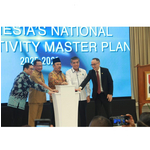
One of the highlights of the meeting was the official handing-over ceremonies under APO flagship programs to mark their launch. The National Agriculture and Food Research Organization (NARO) of Japan was recently designated as the new Center of Excellence (COE) on Climate-smart Agriculture, showcasing how technology can revolutionize productivity in the agricultural sector, while the latest APO-accredited Certification Body (CB), the Productivity Certification Body of Pakistan (PCBP), is now offering certification to qualified specialists to drive productivity agendas. The handing-over ceremonies and special presentation on the COE created further interest in those flagship programs among APO members.
In line with the monitoring and evaluation framework of the APO Vision 2025, the GBM approved a “pause-and-reflect” exercise to ensure that the APO is on the right track to achieving its goals and objectives, adapting to the changing environment, and continuing to add value to member economies.
The prosperity and growth seen in the region are dependent on the tireless efforts of productivity champions, and the APO recognizes their significant contributions through its productivity award schemes. Established in 1978, with the most recent revisions approved by the GBM in 2021, the APO now offers three categories, Regional Award, Meritorious and Distinguished Award, and the National Award. For more details, visit https://www.apo-tokyo.org/about-the-apo-awards/.
In closing, APO Alternate Director and NPO Head for Malaysia Dato' Abdul Latif Haji Abu Seman expressed profound gratitude for the delegates’ robust discussions and contributions over the course of the meeting. “We will carry forward that spirit of collaboration, lessons learned, and decisions taken to continue working toward our goals,” he pledged. He was delighted to extend an official invitation to delegates to Malaysia as the host of the 66th GBM.
The annual GBM continues to be central in strengthening relationships among the diverse APO members and their commitment to the shared mission of enhancing productivity in the Asia-Pacific.
About the APO
The Asian Productivity Organization (APO) is a regional intergovernmental organization dedicated to improving productivity in the Asia-Pacific region through mutual cooperation. It is nonpolitical, nonprofit, and nondiscriminatory. Established in 1961 with eight founding members, the APO currently comprises 21 member economies: Bangladesh; Cambodia; the ROC; Fiji; Hong Kong; India; Indonesia; I.R. Iran; Japan; the ROK; Lao PDR; Malaysia; Mongolia; Nepal; Pakistan; the Philippines; Singapore; Sri Lanka; Thailand; Turkiye; and Vietnam.
The APO is shaping the future of the region by fostering the socioeconomic development of its members through national policy advisory services, acting as a think tank, institutional capacity-building initiatives, and knowledge sharing to increase productivity.
Contacts
For details contact:
Digital Information Unit, APO: pr@apo-tokyo.org
Phone: +81-3-3830-0411
Website: https://www.apo-tokyo.org.