Endometriosis Researchers One Step Closer to Diagnosing Condition With Menstrual Blood
Endometriosis Researchers One Step Closer to Diagnosing Condition With Menstrual Blood
Feinstein Institutes scientists leading the Research OutSmarts Endometriosis (ROSE) clinical study publish new data in BMC Medicine
MANHASSET, N.Y.--(BUSINESS WIRE)--Since 2016, scientists at The Feinstein Institutes for Medical Research have studied the genetic and cellular makeup of menstrual blood or menstrual effluent (ME) to diagnose endometriosis. Today they published a new study in Springer Nature’s BMC Medicine that shows their ability to use ME to identify patients who may have endometriosis.
Endometriosis occurs when uterine-like tissues grow outside of the uterus and form lesions. The condition affects one in 10 reproductive-age females, resulting in chronic, often debilitating pain or infertility and other medical complications. Due to the lack of non-surgical diagnostic tools, it can often take seven to 10 years to be diagnosed with endometriosis. Currently, invasive laparoscopic surgery is the only definitive diagnostic method.
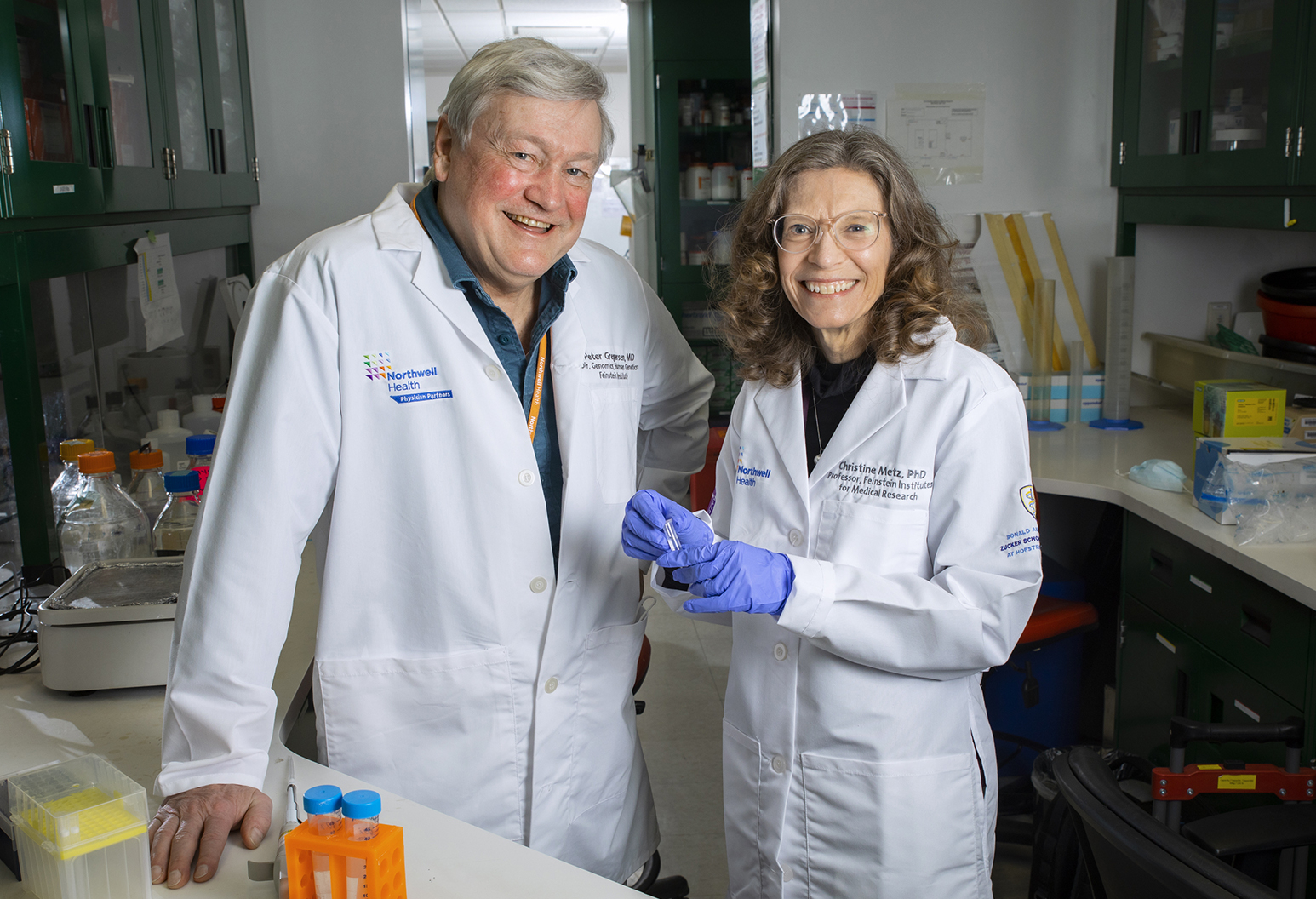
The research, led by Peter Gregersen, MD, and Christine Metz, PhD, analyzed the genetic and cellular differences in healthy controls versus endometriosis subjects to find common biomarkers that could lead to new diagnostic approaches and potential treatments. Building off more than seven years of research, the new study published in BMC Medicine outlines the first use of single-cell RNA-sequencing (scRNA-Seq) to compare endometrial tissues in freshly collected ME from 33 study participants.
“Millions of adolescents and women suffer from endometriosis without a proper diagnosis, delaying their care and extending their pain,” said Dr. Metz, professor in the Institute of Molecular Medicine at the Feinstein Institutes and co-director of Research OutSmarts Endometriosis (ROSE) study. “This new paper describes the potential for a novel screening tool to identify endometriosis earlier and enable patients to get the help they need.”
The published study shows for the first time that the characteristics of endometrial tissue that shed into ME are distinct in patients with endometriosis compared to control (healthy) subjects. When combined with clinical symptoms, there is a potential to use ME to screen or diagnose adolescents and women who may be suffering with symptoms of endometriosis.
“ROSE study research helps us understand the molecular and genetic makeup of endometrial tissues in ME from women with endometriosis,” said Dr. Gregersen, professor in the Institute of Molecular Medicine at the Feinstein Institutes and co-director of the ROSE. “More than 2,000 women have participated in the ROSE study to date and we are grateful to them for helping us to produce knowledge that will improve patients’ lives.”
In order to further validate these findings, the team has recently initiated a new clinical trial to compare ME from symptomatic women who have not been diagnosed but will undergo the necessary surgery as part of their standard care to determine if they have the condition. Studies are also underway to investigate ME in symptomatic and non-symptomatic adolescents to predict endometriosis at earlier ages and stages.
“While endometriosis is a common condition, there continues to be a lack of diagnosis and proper early intervention,” said Kevin J. Tracey, MD, president and CEO of the Feinstein Institutes. “These important findings by Drs. Gregersen and Metz hold promise to change our understanding of this disease and focus on improving the diagnosis and care they need.”
About the Feinstein Institutes
The Feinstein Institutes for Medical Research is the home of the research institutes of Northwell Health, the largest health care provider and private employer in New York State. Encompassing 50 research labs, 3,000 clinical research studies and 5,000 researchers and staff, the Feinstein Institutes raises the standard of medical innovation through its five institutes of behavioral science, bioelectronic medicine, cancer, health system science, and molecular medicine. We make breakthroughs in genetics, oncology, brain research, mental health, autoimmunity, and are the global scientific leader in bioelectronic medicine – a new field of science that has the potential to revolutionize medicine. For more information about how we produce knowledge to cure disease, visit http://feinstein.northwell.edu and follow us on LinkedIn.
Contacts
Matthew Libassi
631-793-5325
mlibassi@northwell.edu