

Gartner Says Executive Leaders Must Act Now in Evaluating 7 Trends for an Effective Strategic Planning Process
Gartner Says Executive Leaders Must Act Now in Evaluating 7 Trends for an Effective Strategic Planning Process
Function-Specific Strategic Planning Templates Are Available for Complimentary Download
STAMFORD, Conn.--(BUSINESS WIRE)--While many long term plans were put off due to the COVID-19 pandemic, executive leaders should act now in implementing a strategic planning process for future revenue growth, according to Gartner, Inc.
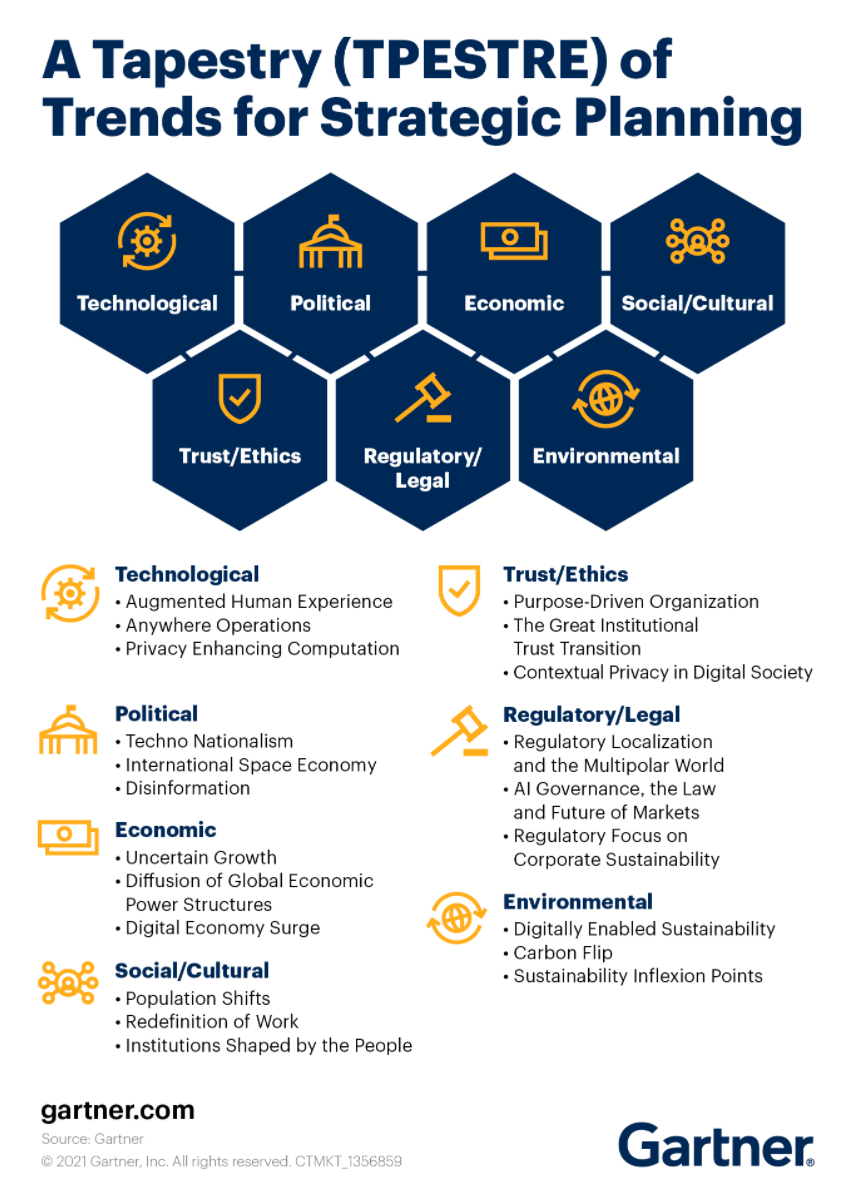
Organizations must actively prepare to respond to future disruptions and anticipate change. Executive leaders should evaluate the use of technological, political, economical, social/cultural, trust/ethics, regulatory/legal, and environmental (TPESTRE) — what Gartner refers to as a “Tapestry” — factors and analysis to identify relevant accelerators and inhibitors (see Figure 1).
“To succeed in a disruptive future, enterprises must continuously scan and respond to disruptions that will impact and/or threaten to protect the company’s place in the markets where they’ve chosen to compete. These disruptions can undo the digital transformation companies have worked so hard to achieve,” said Marty Resnick, vice president, analyst at Gartner. “Executive leaders must evaluate a variety of trends, beyond just technology, and their impact on strategic planning.”
Gartner segments key trends and disruptions into seven major categories, so executives can begin to build planning assumptions most relevant for their strategic plans. The key trend areas to evaluate include:
- Technological: The evolution, impact and disruption of technology change.
- Political: Attitudes, institutions and legislation shifting the political environment.
- Economic: Factors in the local and global economic environment that influence businesses and governments.
- Social/Cultural: Attitudes, behaviors and lifestyles of individuals and societal groups.
- Trust/Ethics: Ethical expectations, behaviors, duties and biases of people and companies toward one another and society.
- Regulatory/Legal: Changes in laws and governmental policies and regulations to reward or punish particular behaviors.
- Environmental: Technical, political, economic, cultural, ethical and legal changes supporting environmental protection and sustainability.
Resnick said organizations need to be deliberate about scouting for trends by incorporating trendspotting, which is the acquisition and evaluation of trends that may impact the organization. A survey of 154 business and IT leaders in February of this year found that only 38% of organizations performing trendspotting had a defined, or formal process. Most used an ad hoc approach.
“A deliberate approach ensures that executive leaders consider trends and disruptions that exist outside of their core responsibilities, where emerging trends might be more familiar,” Resnick said. “Executives who are not adequately trendspotting already likely will miss critical inputs to their strategic assumptions and planning. This leaves their organization exposed to blind spots and risk, limiting their ability to capitalize on these opportunities.”
Build a Strategic Plan By Function
Executive leaders can leverage Gartner tools to build their own strategic plan. There are templates available to download for function-specific plans, including audit, finance, human resources, information technology, marketing, sales, supply chain, and more. Visit the Strategic Planning section on Gartner’s website for additional information.
Resnick will also provide additional details in the complimentary Gartner webinar The 7 Key Trend Areas to Factor Into Your Strategic Planning on August 30 at 11 am EDT.
About Gartner
Gartner, Inc. (NYSE: IT) is the world’s leading research and advisory company and a member of the S&P 500. We equip business leaders with indispensable insights, advice and tools to achieve their mission-critical priorities and build the successful organizations of tomorrow.
Our unmatched combination of expert-led, practitioner-sourced and data-driven research steers clients toward the right decisions on the issues that matter most. We are a trusted advisor and an objective resource for more than 14,000 organizations in more than 100 countries — across all major functions, in every industry and organization size.
To learn more about how we help decision makers fuel the future of business, visit gartner.com.
Contacts
Meghan Rimol
Gartner
+1 571 303 4009
meghan.rimol@gartner.com
