Large Number of Americans Reported Financial Anxiety and Stress Even Before the Pandemic
Large Number of Americans Reported Financial Anxiety and Stress Even Before the Pandemic
New study finds lack of financial literacy linked to high levels of stress and anxiety
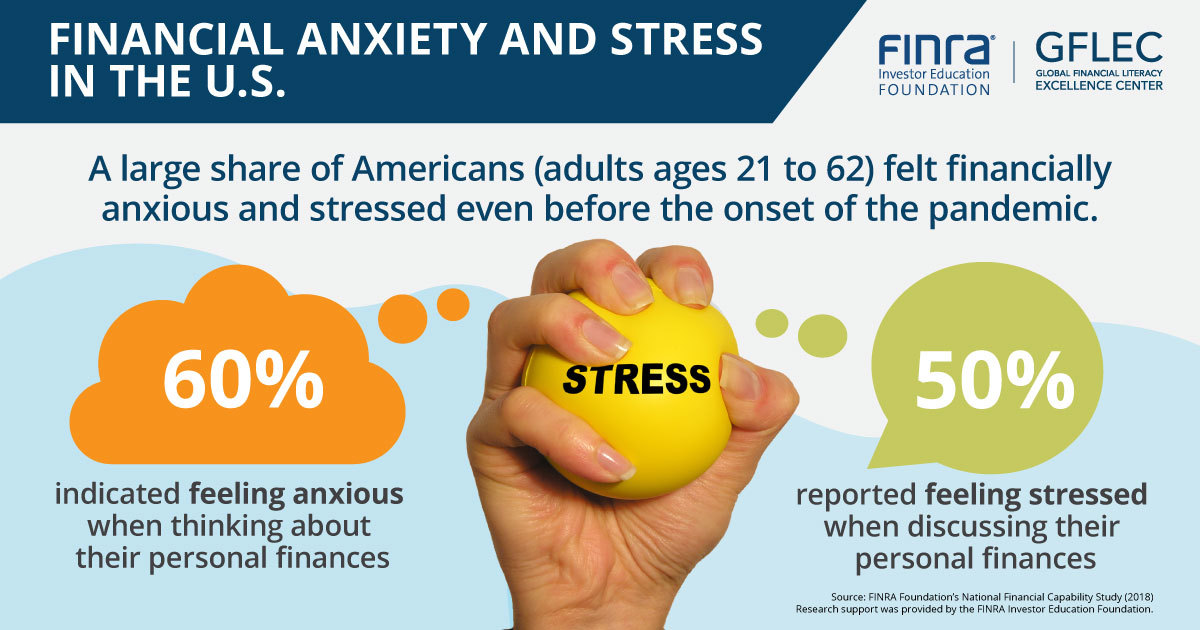
WASHINGTON--(BUSINESS WIRE)--A substantial number of adults in the United States between the ages of 21 and 62 felt anxiety and stress about their personal finances well before the onset of the COVID-19 pandemic, according to a new report published today. Researchers found that financial stress and anxiety are highly linked to low levels of financial literacy, problematic financial behaviors and decreased financial security.
Researchers at the Global Financial Literacy Excellence Center at the George Washington University and the FINRA Investor Education Foundation used data from the foundation’s 2018 National Financial Capability Study, as well as focus groups conducted in December 2020, to examine the prevalence of financial anxiety and stress among adults in the U.S. and the factors that likely contribute to higher levels. They also looked at the long-term consequences of these feelings.
“Our research offers important findings on the newly explored topic of financial stress and anxiety. Alarmingly, we find that even prior to the pandemic, more than half of American adults were experiencing financial anxiety,” Annamaria Lusardi, Ph.D., academic director of the Global Financial Literacy Excellence Center and University Professor of Economics and Accountancy at GW, said. “A multifaceted approach will be needed to address this problem; including a systematic increase in financial knowledge, which can happen through policy and programs.”
The researchers looked at survey answers from more than 19,000 adults in the U.S. and analyzed evidence collected during focus groups. Here are the key findings from the report:
- 60% of respondents indicated feeling anxious when thinking about their personal finances, while 50% of respondents indicated feeling stressed when discussing their finances.
- 65% of women indicated feeling anxious about their personal finances compared to 54% of men.
- Major factors contributing to high levels of financial anxiety and stress include a lack of assets and insufficient income, high debt, money management challenges and low financial literacy.
- Women, young adults, people with financially dependent children, and those who are low-income, unmarried and unemployed are most financially anxious.
- People with high financial anxiety were more likely to have past-due bills for the treatment of a health problem.
- Focus group respondents said that having too many expenses and monthly bills, especially medical expenses, were major factors contributing to high anxiety.
“These findings are sobering. Over the past year, Americans’ financial struggles, anxiety and stress levels have likely worsened,” Andrea Hasler, Ph.D., deputy academic director of the Global Financial Literacy Excellence Center and an assistant research professor of financial literacy at GW, said. “Focus group discussions reveal that for most participants, the pandemic seems to have exacerbated existing financial anxiety, rather than creating new anxiety that was not present pre-pandemic. Thus, it’s more important than ever to build financial resilience and make it part of the recovery path.”
“What our research reveals about the arc and the extent of financial anxiety and stress in America prior to the global pandemic is troubling,” Gerri Wash, president of the FINRA Foundation, said. “Our qualitative interviews underscore the potential severity of the pandemic’s impact on Americans’ mental and financial health today, as well as the important role of financial literacy.”
Given the connection between low financial literacy and anxiety and stress, the researchers recommend increasing efforts aimed at improving financial knowledge levels especially among high-risk groups. Other recommendations provided by the researchers to help ease financial anxiety and stress include:
- Adults, particularly those at risk of experiencing financial anxiety or stress, should be encouraged to set aside emergency savings. Even small savings can help buffer against future financial shocks, potentially providing relief to stressed and anxiety-ridden households.
- Employers can offer workplace financial wellness programs that address money management topics and options to automatically save for the future.
- Employers can also offer resources to help individuals cope with the anxiety and stress stemming from their financial situation.
- Personal finance experts—such as advisors, counselors and planners—should take heed of the harmful effects of financial anxiety and stress on their clients.
Access the report here.
ABOUT THE FINRA INVESTOR EDUCATION FOUNDATION
The FINRA Investor Education Foundation supports innovative research and educational projects that give underserved Americans the knowledge, skills and tools to make sound financial decisions throughout life. For more information about FINRA Foundation initiatives, visit www.finrafoundation.org.
ABOUT GFLEC
Founded in 2011 at the George Washington University School of Business, the Global Financial Literacy Excellence Center (GFLEC) has positioned itself to be the world’s leader in financial literacy research and policy. Through rigorous scholarship and research, wide-reaching education, and global policy and services, the Center aims to improve financial literacy around the globe. Visit https://gflec.org/ for more information.
Contacts
MEDIA:
Timothy Pierce: tpie@gwu.edu, 202-994-5647
Angelita Williams: angelita.williams@finra.org, 202-728-8988