New Ginger Data Challenges CEOs to Step Up Support of Employee Mental Health
New Ginger Data Challenges CEOs to Step Up Support of Employee Mental Health
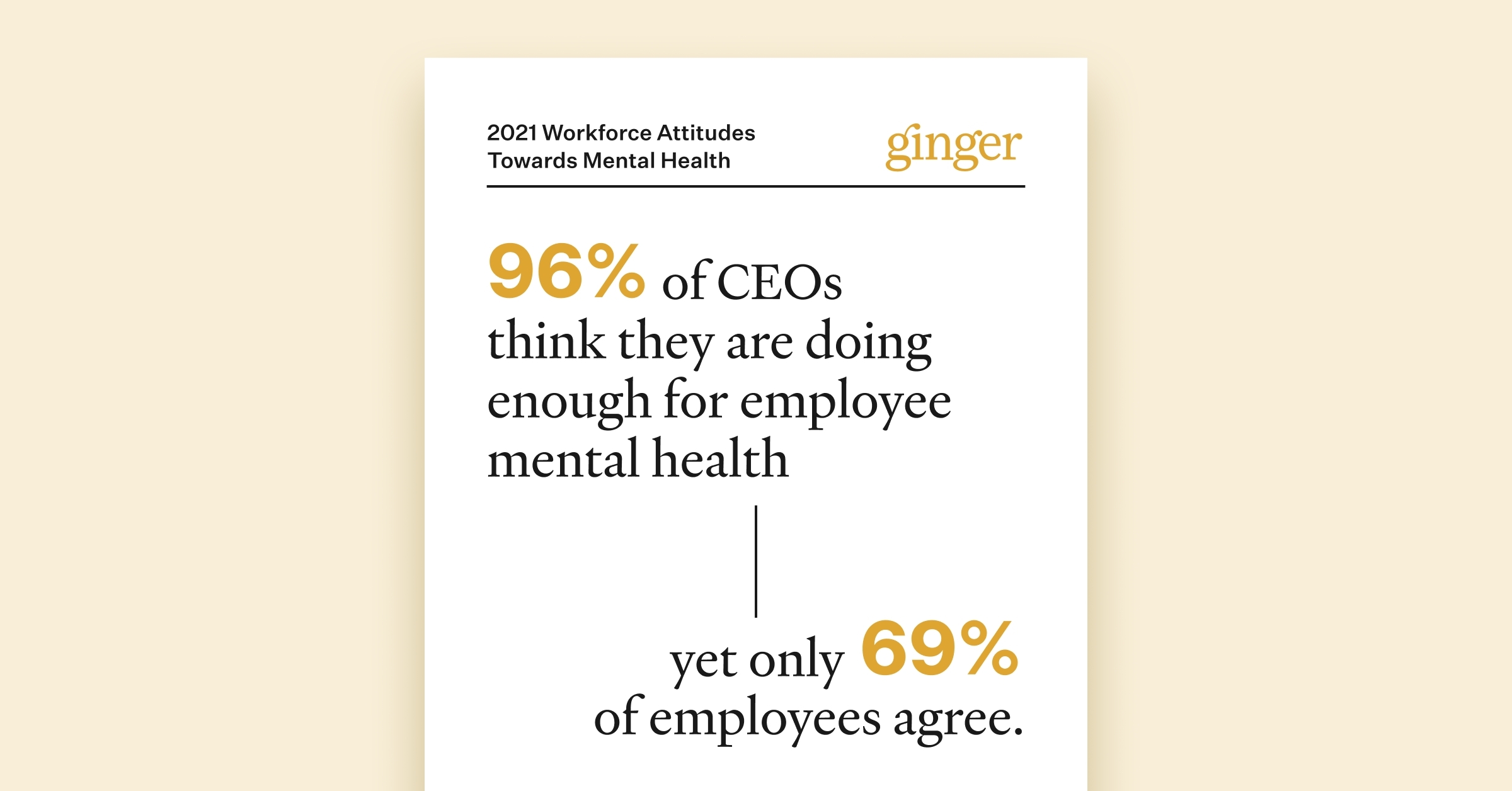
96% of CEOs believe their companies are doing enough for employee mental health, yet only 69% of employees agree
Though nearly half of workers report experiencing high to extreme stress over the past year, they are also more likely than ever to seek the help they need
SAN FRANCISCO--(BUSINESS WIRE)--Ginger, the leader in on-demand mental healthcare, today announced new data reflecting the perspectives of U.S. workers and company CEOs on mental health. Ginger’s Third Annual Workforce Attitudes Toward Mental Health Report, fielded in February 2021, compiled data from 1,229 U.S. full-time workers and over 150 CEOs to understand the views and behaviors toward mental health of employees and their most senior leaders, one year through the pandemic.
CEOs overwhelmingly believe that strong worker mental health results in better business outcomes.
Nearly all CEOs surveyed report both investing in their own mental health and increasing their company’s focus on mental health as a result of the pandemic.
- 80% of CEOs believe that poor employee mental health negatively impacts worker productivity.
- 94% of CEOs report having received mental health support themselves over the past year.
- More than half of CEOs report that talking about mental health makes them a better leader (and nearly 90% of employees appreciate it) - even though 56% of them are concerned it might impact their credibility.
- 92% of CEOs report that their companies have increased focus on mental health as a result of the pandemic.
The average U.S. worker is much less likely than a CEO to feel their company does enough to support mental health.
The more senior the worker, the more likely they are to view their company’s support of mental health positively.
- 96% of CEOs believe they are doing enough for employee mental health, but only 69% of employees feel the same.
- The average worker is half as likely as CEOs to say their companies are accepting of mental health issues.
- Individual contributors report that their companies offer mental health benefits only half as often as CEOs do.
From skilled workers to CEOs, U.S. employees continue to experience high-levels of stress and are increasingly relying on technology-based mental healthcare for help.
48% of employees report experiencing high to extreme stress over the past year - a 7% increase over the last two years. Yet, over the same time period, the number of employees who have used technology-based mental health support has increased significantly by 66%.
- More than three-quarters of employees who worked with a mental health professional did so virtually in the past year.
- Executives (70%), skilled workers (71%), and workers with caregiving responsibilities (57%) are significantly more likely to prefer virtual mental health support.
- 95% of people who received mental health support over the last year reported that it helped them at work.
“The increased focus on mental health in the C-suite will benefit both shareholders and workers. As more people take steps to manage their mental health, CEOs should use this momentum to invest in accessible mental health benefits, and to take a leading role in educating employees about the importance of mental health,” said Russell Glass, CEO of Ginger. “Our data shows that this is truly the ‘last-mile’ challenge in mental healthcare. As we strive to create a world where mental health is never an obstacle, employers have a critical role in de-stigmatizing mental health, and ensuring their teams know how to get help.”
Partnering together with its employer clients, ranging from SMBs to Fortune 500s, Ginger takes an active role in ensuring that workers are aware of how to get support, whenever and wherever they need it. Ginger strives to normalize mental health and meet people where they are through customizable communications plans, focusing on relatable topics like parenting, relationships, and career changes. After several months of partnering with a Fortune 50 company on marketing efforts for Ginger, these campaigns drove an increase in sign-up rates by over 2x.
"As Ginger's data shows, it's critical that mental health support is top of mind for leaders, particularly as we prepare for a new era in the workplace post-pandemic," said Monte Watkins, VP of HR at Rubrik. "At Rubrik, we're proud to have partnered with Ginger to support the mental health of our employees during a period of tremendous growth for our organization, and a tumultuous time for our world."
The full Third Annual Workforce Attitudes Toward Mental Health Report from Ginger and information on these key findings and other resources is available at www.ginger.io/resources.
About Ginger
At Ginger, we believe that everyone deserves access to incredible mental healthcare. Our on-demand system brings together behavioral health coaches, therapists, and psychiatrists, who work as a team to deliver personalized care, right through your smartphone. The Ginger app provides members with access to the support they need within seconds, 24/7, 365 days a year. Millions of people have access to Ginger through leading employers, health plans and partners. Ginger has been recognized by The World Economic Forum as a Technology Pioneer, Fast Company as one of the Most Innovative Companies in Healthcare and UCSF’s Digital Health Awards as 2020’s leading Mental Health Company. Learn more about our vision to build a world where mental health is never an obstacle at ginger.com.
Contacts
Victoria Barnes
Head of Communications, Ginger
781 249 3738
victoria@ginger.com