Global Smartphone Market Shows Signs of Recovery in Q3
Global Smartphone Market Shows Signs of Recovery in Q3
Xiaomi takes third spot; realme grows fastest at 132% QoQ
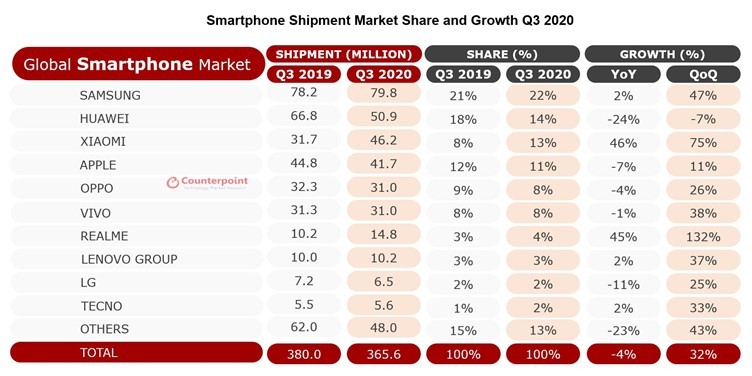
NEW DELHI & HONG KONG & SEOUL & LONDON & BEIJING & SAN DIEGO & BUENOS AIRES--(BUSINESS WIRE)--The global smartphone market declined 4% YoY but grew 32% QoQ to reach 366 million units in Q3 2020, according to the latest research from Counterpoint’s Market Monitor Service. This recovery was driven by all key markets, like the US, India and Latin America, returning slowly to normal due to eased lockdown conditions. The smartphone market has shown resilience to the ill effects of COVID-19 both from the supply and demand side.
Commenting on the overall market dynamics, Associate Director Tarun Pathak said, “Eased lockdown conditions in all key markets made way for exports and imports, thus streamlining the supply chain again. Also, the pent-up demand due to lockdowns helped the smartphone market take a recovery trajectory.”
Samsung regained the top spot, shipping 79.8 million units to register 47% QoQ and 2% YoY growth. This is the highest ever shipment by Samsung in the last three years. The company managed to recover in markets including India, Western Europe and LATAM, driven by new models. In India, Samsung surpassed Xiaomi to become the No. 1 player, driven by the success of the M Series. Huawei was the runner-up in the global market but showed a declining trend as its share dropped from 20% in Q2 2020 to 14% in Q3 2020. Rapid growth of realme continued during the quarter. It grew 132% QoQ in shipments volume, representing the strongest growth momentum among major global OEMs. With this, it became the world’s fastest brand to ship 50 million smartphone units since inception.
Xiaomi grew 75% QoQ to grab 13% share for the quarter. Notably, this was also the first time when Xiaomi surpassed Apple to capture the third spot. Research Analyst Abhilash Kumar said, “Xiaomi reached its highest-ever shipments at 46.2 million units in Q3 2020. In China, Xiaomi’s struggle for growth ended and shipments were up 28% YoY and 35% QoQ. This impressive show by Xiaomi in China was driven by a series of campaigns during the brand’s decennial celebrations in August. Also, in new markets like LATAM, Europe and the MEA, Xiaomi’s share expanded rapidly at Huawei’s expense amid US-China trade sanctions.”
Contacts
Tarun Pathak
tarun@counterpointresearch.com
Varun Mishra
varun@counterpointresearch.com
Abhilash Kumar
abhilash@counterpointresearch.com
Aman Chaudhary
aman.chaudhary@counterpointresearch.com