Whitney Economics Refreshes Analysis of Federal Tax Impact on Legal Cannabis Operators
Whitney Economics Refreshes Analysis of Federal Tax Impact on Legal Cannabis Operators
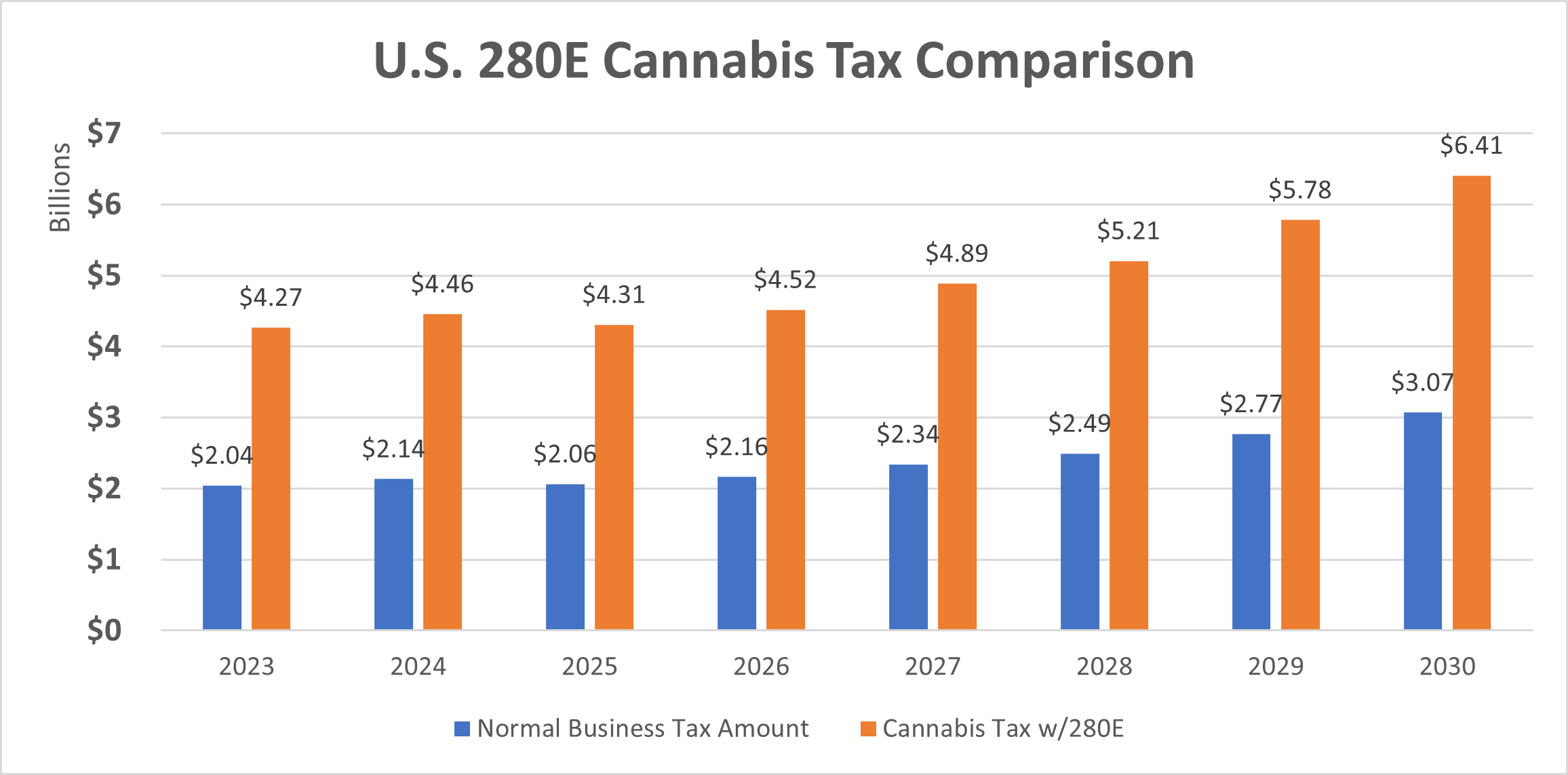
In 2025, $2.24 Billion was Collected Due to the IRS 280E Tax Policy
PORTLAND, Ore.--(BUSINESS WIRE)--Whitney Economics (WE), a global leader in cannabis and hemp business consulting, data, and economic research, today announced it has refreshed its analysis on the impact federal taxes continue to have on U.S. state-regulated legal cannabis operators.
“The amount of additional taxes cannabis operators pay is staggering,” Whitney Economics Chief Economist Beau Whitney said. “In 2025, there was an estimated $2.24 billion in excess cannabis-related federal taxes due to the IRS’s 280E tax policy."
Share
“The amount of additional taxes cannabis operators pay is staggering,” Whitney Economics Chief Economist Beau Whitney said. “In 2025, there was an estimated $2.24 billion in excess cannabis-related federal taxes due to the IRS’s 280E tax policy. The industry is being taxed out of business.”
Cannabis remains listed on the Controlled Substances Act (CSA) as a federally illegal Schedule One drug. As a result, state-licensed cannabis operators are not permitted to make common or ordinary deductions on their federal tax returns. These deductions may include labor, legal fees, marketing, security or banking. With fewer deductions, cannabis operators, particularly those in retail, have an effective tax rate that at times can approach 70% or more.
This tax liability was originally intended at the federal level to be punitive and serve as a disincentive to conduct illicit drug-related business. While the cannabis industry has evolved at the state level, the federal tax policy has not changed in the 40 years since it was adopted. At this level of taxation, cannabis operators are literally being taxed out of business, which is why federal tax policy is at the forefront of the discussions related to rescheduling cannabis in the U.S.
If cannabis is rescheduled from Schedule One to Schedule Three, for example, cannabis operators would no longer be subject to 280E taxation. This would be a major boost to an industry struggling with cash flow and profitability. It would also increase business valuations and would attract new investment.
Since 2018, the cannabis industry has paid more than $27 billion in federal taxes, of which $15 billion is in excess 280E-related taxes. “With pricing compression occurring in every major U.S. cannabis market, tax revenues will no longer be the goose that laid the golden egg,” Whitney said. “In fact, declining state cannabis tax revenues are resulting in state cannabis tax increases, which will further hurt revenues, making the overall tax situation untenable for the industry.”
Given the lack of banking access, combined with heavy taxes, the cannabis industry faces many financial burdens that could easily be remedied with some focus and effort at the federal level. “The timing of this reform, though, is still subject to significant speculation, especially with the change of the U.S. Attorney General,” Whitney said. “We feel it is not a matter of if, but when this reform will occur.”
Although cannabis operators remain hopeful about the reform, the tax policy will remain in effect for the foreseeable future. “We are advising operators in the industry to remain fiscally disciplined, despite the prospect of future reform,” Whitney said. “Too many operators may be counting on this reform for their survival. They need to stay the course but be prepared to pivot quickly once the tax policy change occurs.”
About Whitney Economics
Portland, Oregon-based Whitney Economics is a global leader in cannabis and hemp business consulting, data, and economic research, supporting hemp and cannabis operators, investors and regulators. Whitney Economics does not take a position on the legalization of cannabis, nor does it take positions on proposed legislation. Visit whitneyeconomics.com.
Contacts
Media contact:
John McIsaac
john@mcisaacpr.com
503-481-9621 (West Coast)