Azul Report: 88% of CFOs Say Their Cloud Spend Is Rising, With 45% Citing Cloud Optimization as Key to Funding AI and Protecting Margins
Azul Report: 88% of CFOs Say Their Cloud Spend Is Rising, With 45% Citing Cloud Optimization as Key to Funding AI and Protecting Margins
Rising cloud spend, AI complexity, and board scrutiny push CFOs to rethink how cloud investments are governed and optimized
SUNNYVALE, Calif.--(BUSINESS WIRE)--Azul, the trusted leader in enterprise Java for today’s AI and cloud-first world, today released its CFO Cloud Cost Optimization Report, revealing how finance leaders are reshaping cloud governance as cloud costs rise, AI adoption accelerates and cloud economics become a board-level issue. Based on a Censuswide survey of 300 U.S. CFOs and senior finance leaders, the research shows that cloud spending is no longer viewed as a passthrough IT expense, but as a strategic financial lever that directly impacts innovation capacity, profitability and enterprise resilience.
"Organizations that optimize at the infrastructure level, starting with how their software consumes compute resources, gain a meaningful advantage in funding the innovations that drive growth."
Share
Cloud Costs Are Rising, and CFOs Are Taking Notice
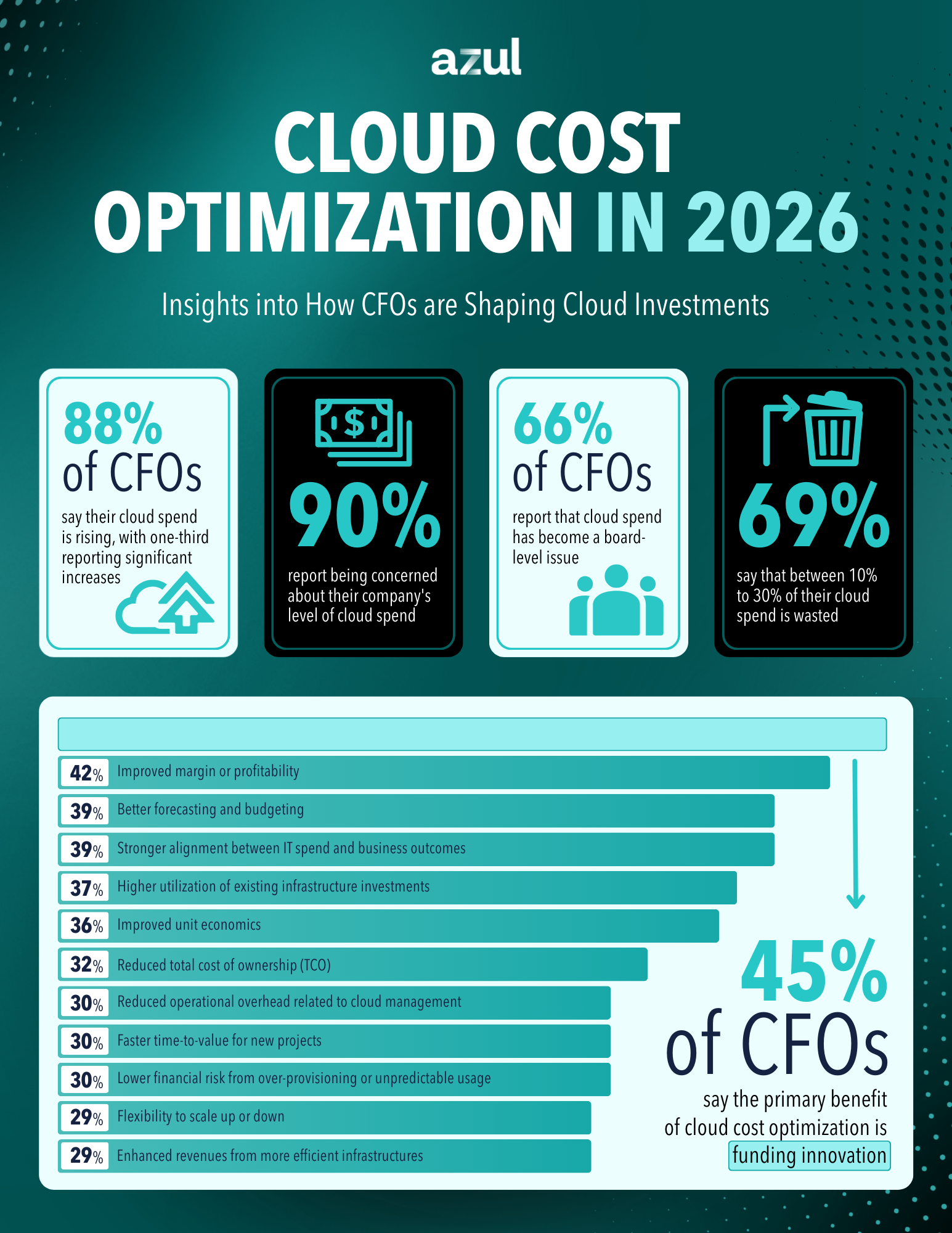
Nearly nine in ten respondents (88%) report that their cloud spending is increasing, with one-third describing the rise as “significant,” underscoring growing pressure to improve financial discipline as cloud usage scales. Only 9% say their cloud spend is staying flat, reinforcing the urgency to address waste as usage continues to grow.
This concern is now reaching the highest levels of governance. Two-thirds (66%) of CFOs say cloud spend has become a board-level issue, signaling a decisive shift in accountability from IT alone to the executive suite and boardroom.
AI Investment Creates a New Financial Tension
While cloud costs continue to climb, CFOs are under growing pressure to invest in innovation. More than half (56%) of CFOs cite AI and automation as their top financial priority, followed by improving cash flow and working capital efficiency (52%), and reducing overall cloud costs (40%). Yet AI adoption is also making cloud cost management more difficult. Over forty percent (43%) of CFOs say AI is adding new layers of workload complexity, complicating forecasting and cost control efforts at a time when predictability is increasingly critical.
This dynamic has created a clear mandate for finance leaders: fund AI initiatives by reducing costs in other areas. With cloud spend accounting for a significant portion of overall IT budgets, organizations are forced to rethink how efficiently their applications consume cloud resources.
CFOs Acknowledge Structural Cloud Waste
As scrutiny increases, finance leaders are also recognizing the scale of inefficiency embedded in many cloud environments. More than two-thirds of CFOs believe that up to 30% of their cloud spend is wasted, representing a significant drag on profitability and financial predictability. Rather than viewing cloud waste as an isolated issue, the report shows CFOs increasingly see it as a structural efficiency problem — one that requires better governance, deeper visibility and more effective optimization across infrastructure and applications.
CFOs Turn to New Optimization Levers
To regain control, organizations are deploying a mix of cloud cost management approaches. The most widely used tools focus on visibility and forecasting, including AI-powered cloud spend analytics (45%) and native cloud provider tools (44%).
Notably, CFOs are beginning to embrace deeper technical levers that directly influence cost efficiency. Sixteen percent of organizations already use Java runtime optimization or JVM tuning. In addition, re-platforming or application modernization initiatives (24%) and workload or infrastructure optimization vendors (29%) are cited as strategies finance leaders are using to manage cloud costs. These modernization efforts help organizations improve performance efficiency, reduce resource consumption, and modernize legacy systems that drive overspending.
Cloud Optimization as an Enabler of Innovation
CFOs do not view cloud optimization purely as a cost-cutting exercise. At the top of the list of main financial benefits they would prioritize, 45% of CFOs say the primary financial benefit of cloud cost optimization is increased budget flexibility to fund innovation, including AI and digital initiatives. Other top benefits include improved margins and profitability (42%), better forecasting and budgeting (39%), and stronger alignment between IT spend and business outcomes (39%). Another 37% cite “higher utilization of existing infrastructure,” signaling a desire to extract more value from current systems.
Rather than a tactical cost exercise, cloud optimization is emerging as a strategic financial lever for CFOs to fund innovation, protect margins and ensure cloud investments deliver measurable business returns.
CFO Top Priorities for the Next 12 Months
CFOs and finance leaders shared their top cloud-related priorities for the next year, balancing innovation goals with heightened financial discipline as cloud spending continues to rise. Improving performance and uptime (43%) topped the list, followed by reducing overall cloud costs (39%) and maximizing profitable growth from cloud investments (38%). In addition, gaining visibility into current spending (35%), compliance and governance (34%) and supporting AI/ML initiatives also made the list. Together, these priorities highlight a clear mandate for finance leaders to ensure cloud investments support AI-driven innovation while delivering predictable, measurable returns and protecting margins.
“With nearly nine in ten CFOs seeing cloud costs rise and AI now a top investment priority, finance leaders are being forced to rethink how efficiently their applications consume cloud resources,” said Scott Sellers, co-founder and CEO of Azul. “Cloud optimization has become a strategic lever — one that allows organizations to fund AI innovation, protect margins and bring greater predictability and accountability to cloud investments. Organizations that optimize at the infrastructure level, starting with how their software consumes compute resources, gain a meaningful advantage in funding the innovations that drive growth.”
To read the full report, visit: Cloud Cost Optimization in 2026: Insights into How CFOs are Shaping Cloud Investments.
FAQs
How much cloud spend do enterprise organizations actually waste?
According to a 2026 Censuswide survey of 300 U.S. CFOs and finance leaders, the average estimated cloud waste sits at nearly a quarter (23%) of total spend. The vast majority of finance leaders are concerned about their organization’s current cloud cost levels. Nearly nine in ten say cloud spending is increasing, yet two-thirds report it has escalated to a board-level concern, signaling that waste is no longer an IT problem but a financial governance issue. Azul’s CFO Cloud Cost Optimization Report finds that the gap between what organizations spend and what they actually consume is driven less by overspending and more by structural inefficiency in how applications consume compute resources.
Why aren’t cloud cost management tools actually reducing cloud waste?
Most enterprises are investing in the wrong layer of the problem. According to Azul’s 2026 CFO Cloud Cost Optimization Report, nearly half of organizations use AI-powered cloud spend analytics and native cloud provider tools, but only 16% use Java runtime optimization or JVM tuning, which directly reduces the compute resources applications consume. Visibility tools tell organizations where money is going; they don't change how efficiently applications use the infrastructure they’re running on. For the nearly half of CFOs who say their top financial benefit from cloud optimization would be freeing budget to fund AI and innovation, the enabling strategy is actually reducing consumption at the application layer, not just monitoring it.
How are CFOs freeing up budget for AI without increasing overall technology spend?
With the majority of CFOs citing AI and automation investment as their top financial priority for 2026, the pressure to fund new initiatives without expanding budgets has made cloud cost optimization a strategic lever rather than a back-office exercise. Azul’s CFO Cloud Cost Optimization Report finds that nearly half of finance leaders say their primary benefit from cloud optimization is increased budget flexibility to fund innovation, making cloud efficiency directly tied to AI investment capacity. Organizations that optimize at the infrastructure level, particularly through application-level compute efficiency, can recapture meaningful portions of their wasted cloud spend without arduous re-platforming, re-architecture or migrating workloads.
About the Report
The research was conducted by Censuswide among 300 U.S. CFOs and finance leaders at organizations with 500 or more employees and annual revenue exceeding $50 million. The data was collected between October 30, 2025 – November 11, 2025. Censuswide abides by and employs members of the Market Research Society and follows the MRS code of conduct and ESOMAR principles. Censuswide is also a member of the British Polling Council.
About Azul
Azul is the trusted leader in enterprise Java for today’s AI and cloud-first world. Its open source-based Java platform empowers organizations to optimize the entire Java lifecycle to accelerate performance, strengthen security, reduce licensing and cloud costs, and boost developer productivity. Azul powers mission-critical systems for 36% of the Fortune 100, 50% of the Forbes Top Ten World’s Most Valuable Brands, and the world’s top 10 financial trading companies. Learn more at azul.com and follow @azulsystems.
Contacts
Media Contact for Azul:
Treble
Josh Georgiou
azul@treblepr.com