Surging Wireless Vulnerabilities Put Corporate Trade Secrets, National Security at Risk, Bastille Report Finds
Surging Wireless Vulnerabilities Put Corporate Trade Secrets, National Security at Risk, Bastille Report Finds
Inaugural “State of Wireless Security” Report Reveals Wireless Threats Are Accelerating 20x Faster Than Overall Cyber Threat Landscape
Report Highlights Critical “Visibility Gap” as Nation-State Actors Target AI Data Centers, Critical Infrastructure, and Unmanaged IoT Devices
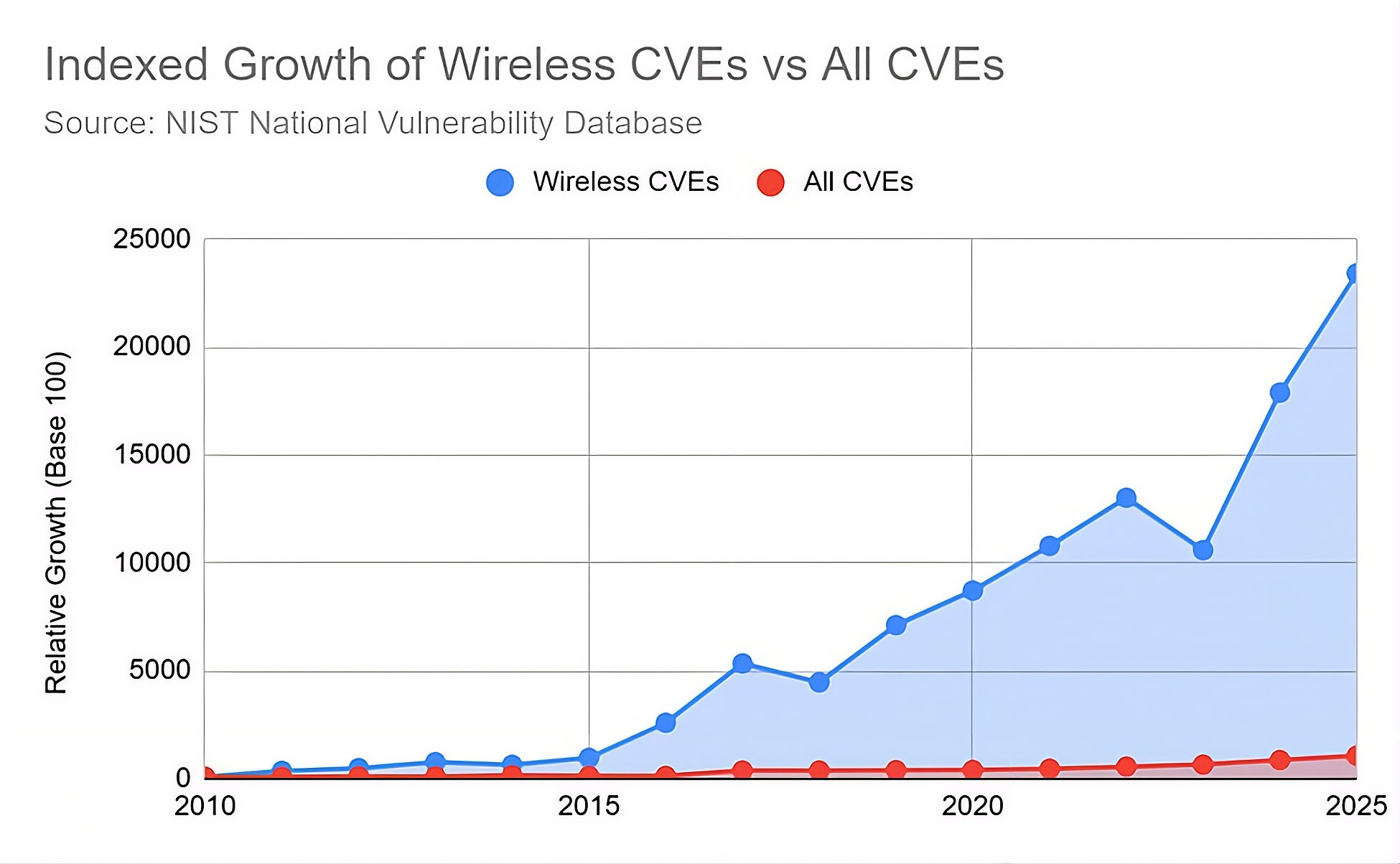
SANTA CRUZ, Calif.--(BUSINESS WIRE)--Bastille Networks, the leader in enterprise wireless airspace cybersecurity, today announced the release of its inaugural annual threat report, “The State of Wireless Security in 2026,” revealing a dramatic surge in wireless vulnerabilities that are reshaping enterprise risk in a world that is increasingly operating in a wireless environment.
Wi-Fi, Bluetooth, Zigbee, LTE, and 5G networks have all become foundational to business and government operations around the world. Yet wireless vulnerabilities and exposures are accelerating at an unprecedented pace, with an average of 2.5 discovered per day in 2025 alone. Despite this environment, traditional vulnerability management models that rely on asset inventories, patch tracking, and IP-based scanning fail to address wireless risks and exposure.
“We’ve long said that wireless threats are proliferating, and this report illustrates the alarming extent to which that is the case as well as highlights the theft and espionage risks companies and governments face,” said Bastille CEO Chris Risley. “Anything that can be controlled wirelessly is vulnerable. With the explosion of new AI data centers and other high-value targets worth billions of dollars in intellectual property or trade secrets, now is the time for enterprises to start treating wireless visibility and vulnerability management as foundational security infrastructure.”
Key Findings from the 2026 Report:
- Exponential Growth: Wireless vulnerabilities have grown 20x faster than conventional threats over the last 15 years, increasing from just 4 reported CVEs in 2010 to 937 in 2025, with cumulative totals doubling every 2–4 years since 2014.
- Sustained Acceleration: The industry has seen two consecutive years of cumulative growth exceeding 25% (2024 and 2025), with a combined 60% increase in wireless vulnerabilities since the start of 2024.
- Daily Threat Velocity: In 2025 alone, researchers disclosed 937 new wireless CVEs, averaging 2.5 new vulnerabilities discovered every day.
- Protocol Dominance: Wi-Fi remains the largest source of disclosed vulnerabilities, accounting for over 60% of wireless CVEs, followed by Bluetooth, cellular, and Zigbee.
“What we’re seeing in the data is not a short-term spike but a structural shift in the threat landscape,” said Dr. Brett Walkenhorst, principal researcher and CTO at Bastille Networks. “Wireless vulnerabilities have grown more than 230-fold since 2010 and are accelerating far faster than the overall CVE ecosystem. Because many of these vulnerabilities affect shared chipsets, protocol stacks, and embedded systems that remain in service for years, each year’s disclosures compound a growing base of persistent exposure for enterprises.”
Wireless vulnerabilities will undoubtedly continue to rise in 2026 and beyond as wireless technologies expand into a broader range of enterprise and critical infrastructure use cases and as nation-state actors are likely to play an increasing role in wireless attacks, according to the report. Organizations are increasingly relying on wireless connectivity not only for workforce mobility, but also for building automation, industrial sensors, access control, logistics tracking, and embedded medical and manufacturing devices.
Bastille has been supporting the Intelligence Community and major corporations around the world for years by safeguarding classified information and trade secrets, and by deploying its technology that scans the airspace in key environments such as SCIFs, R&D facilities, data centers, and corporate headquarters. The always-on support helps to detect, classify, and locate every wireless transmitter in a facility – from authorized infrastructure to unmanaged personal peripherals and rogue devices.
Wireless airspace visibility enables security teams to identify threats that bypass traditional perimeters, such as data exfiltration via bugs with cellular modems or unauthorized Bluetooth connections. As the report shows, nation-state actors and foreign government-backed criminal organizations are finding new and increasingly sophisticated ways to exploit wireless vulnerabilities.
The report also notes that wireless vulnerabilities often persist in areas where traditional security controls provide limited visibility, including firmware, drivers, chipsets, and embedded stacks. These weaknesses can be exploited without IP connectivity and often impact multiple vendors due to shared components, making patching inconsistent or impossible for many devices.
To mitigate these risks, Bastille recommends that organizations move beyond traditional vulnerability management and adopt continuous, passive RF spectrum monitoring. By observing the airspace directly, security teams can detect anomalous behavior, such as unauthorized Bluetooth pairing attempts or rogue wireless access points, providing a layer of defense that traditional scanners and endpoint tools cannot see.
The State of Wireless Security in 2026 is available now at https://bastille.net/resource/the-state-of-wireless-security-in-2026/.
About Bastille Networks, Inc.
Bastille is the leader in Enterprise Wireless Airspace Cybersecurity through software-defined radio. By enabling enterprises to assess and mitigate risks associated with cellular, RF, and wireless threats, Bastille delivers security solutions that provide real-time monitoring and actionable insights to protect sensitive data and critical infrastructure.
The Bastille system deploys RF sensors around AI data centers that detect and locate every transmitter in the facility. Bastille uses AI to classify transmissions by type, activity, whether the device is authorized to be on site, and compliance with facility security policies. Bastille does not examine transmission payloads. Instead, it continuously monitors for anomalous behavior that could indicate data exfiltration or system compromise. Bastille’s RF data and analytics can be integrated with other facility security information to provide teams with a more comprehensive situational awareness of their security posture. For more information about Bastille, visit www.bastille.net.
Contacts
Media Contact:
FGS Global
Jeremy Pelofsky
Jeremy.Pelofsky@fgsglobal.com
(202) 425-4643
MacKenzie Smith
MacKenzie.Smith@fgsglobal.com
(202) 262-2650