Sri Lanka Launches National Productivity Master Plan to Power Next Decade of Growth
Sri Lanka Launches National Productivity Master Plan to Power Next Decade of Growth

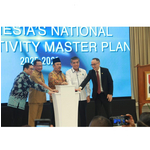
COLOMBO, Sri Lanka--(BUSINESS WIRE)--On 20 November 2025, the Government of Sri Lanka officially launched the National Productivity Master Plan, a five-year roadmap designed to shift the country from crisis recovery to productivity-led, export-oriented growth.
Covering 2024–29, the master plan was developed by the National Productivity Secretariat and the Ministry of Industry and Entrepreneurship Development of Sri Lanka with technical support from the Asian Productivity Organization (APO), which engaged the Korea Development Institute’s Center for International Development to lead the analytical and drafting work together with the APO.
APO Secretary-General Dr. Indra Pradana Singawinata emphasized that the plan is intended to bridge Sri Lanka’s transition from short-term stabilization to long-term structural transformation: “Stabilization has begun, but transformation has not yet been secured. This National Productivity Master Plan is the bridge between short-term stabilization and long-term, self-sustaining prosperity.”
The master plan calls for targeted reforms that prioritize innovation; human capital development; modern infrastructure; smarter, more streamlined public institutions; and sector-specific strategies for key tradable industries. By investing in competitive, tradable sectors and aligning skills with opportunity, Sri Lanka can increase productivity while expanding fiscal buffers, strengthening its external position, accelerating recovery from shocks, and transforming overseas employment from necessity into choice.
The Secretary of the Ministry of Industry and Entrepreneurship Development, J. M. Thilaka Jayasundara, described the launch as “a very happy moment” for Sri Lanka’s long-standing productivity movement and emphasized Sri Lanka’s ambition to embed productivity in every part of society. She highlighted 2030 targets to raise industry’s GDP contribution to 28%, build a stronger manufacturing-based economy, and increase industrial and total export revenues to USD 28 billion and USD 45 billion, respectively.
Hon. Chathuranga Abeysinghe, Deputy Minister of Industry and Entrepreneurship Development, called the master plan “a turning point for the country” and welcomed the proposed establishment of a National Productivity Commission as a key success factor for implementation and monitoring.
Following the launch ceremony, APO Secretary-General Dr. Indra, together with the APO and Korea Development Institute delegation and National Productivity Secretariat officials, paid a courtesy call on Prime Minister Hon. Harini Amarasuriya to formally hand over the master plan and discuss practical pathways for implementation. The courtesy call reaffirmed that productivity is a matter of top-level political attention and that the master plan will be treated as a living agenda for national reform.
About the National Productivity Master Plan 2024–29
The master plan sets out a cross-governmental strategy to raise productivity and competitiveness by prioritizing innovation, skills, infrastructure, and smarter public institutions while supporting the key sectors of agriculture, fisheries, tourism, textiles and apparel, and software and ICT.
About the APO
The Asian Productivity Organization (APO) is a regional intergovernmental organization dedicated to improving productivity in the Asia-Pacific region through mutual cooperation. It is nonpolitical, nonprofit, and nondiscriminatory. Established in 1961 with eight founding members, the APO currently comprises 21 member economies: Bangladesh; Cambodia; the Republic of China; Fiji; Hong Kong; India; Indonesia; Islamic Republic of Iran; Japan; the Republic of Korea; Lao PDR; Malaysia; Mongolia; Nepal; Pakistan; the Philippines; Singapore; Sri Lanka; Thailand; Turkiye; and Vietnam.
The APO is shaping the future of the region by fostering the socioeconomic development of its members through national policy advisory services, acting as a think tank, institutional capacity-building initiatives, and knowledge sharing to increase productivity.
Contacts
For details, contact the APO Digital Information Unit: pr@apo-tokyo.org.
Website: https://www.apo-tokyo.org