38% of Job Seekers Would Reject Offers From AI-Heavy Recruiting Processes, Capterra Reveals
38% of Job Seekers Would Reject Offers From AI-Heavy Recruiting Processes, Capterra Reveals
As employers embrace AI in recruiting, new challenges emerge in balancing automation with the human touch, prompting concerns over candidate experience and employer branding.
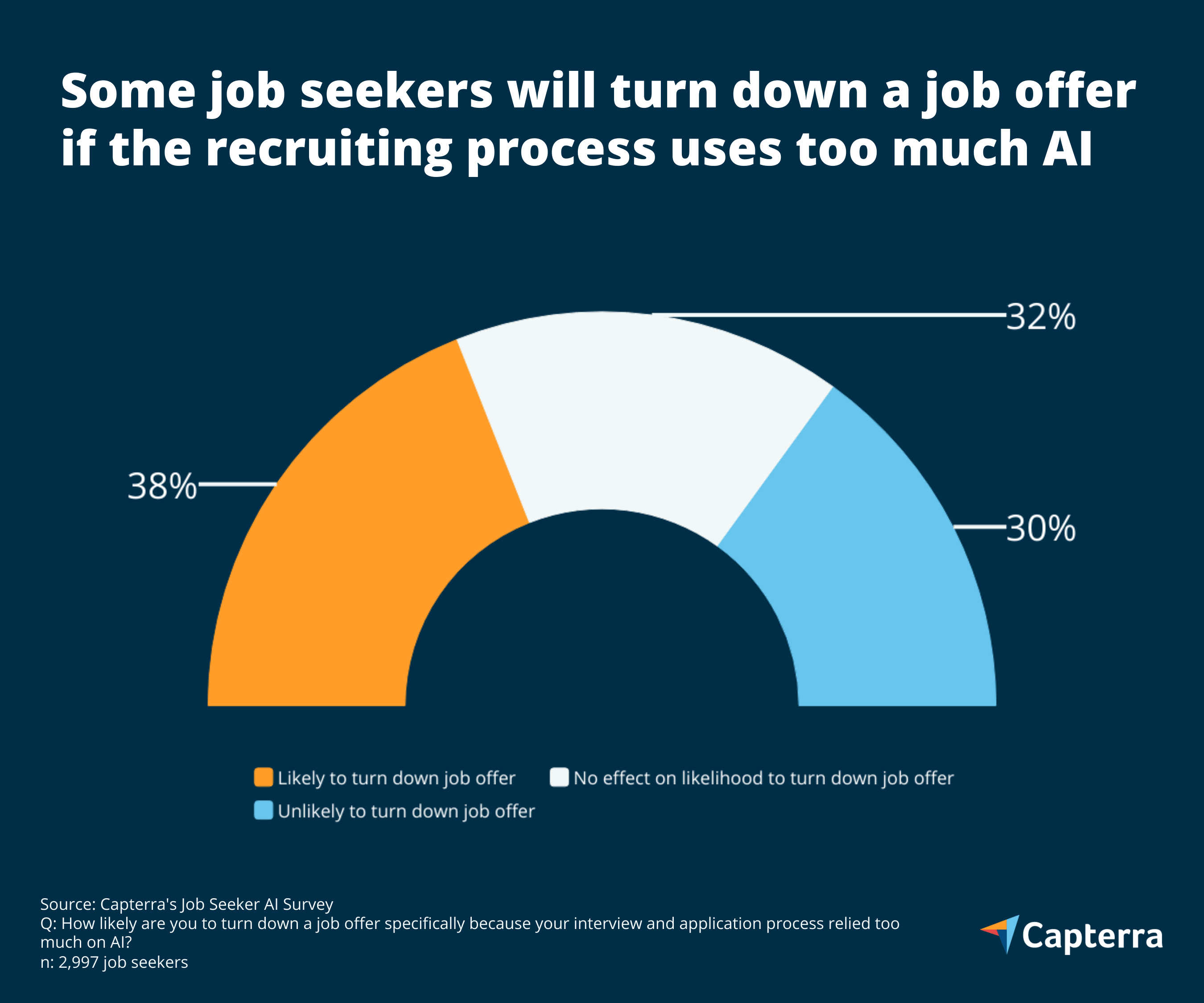
ARLINGTON, Va.--(BUSINESS WIRE)--Employers eager to streamline hiring with artificial intelligence (AI) may be walking a fine line between efficiency and alienation. Capterra’s 2024 Job Seeker AI Survey uncovers a growing problem: while many candidates appreciate the perceived speed and objectivity AI brings to recruiting, there’s a significant risk of turning off top talent if human interaction is lacking.
Employers are rapidly adopting AI in hiring, but over-automation could cost them top talent
AI tools are proving valuable in speeding up various recruiting tasks, from scanning resumes to initial candidate screenings. Instead of feeling shut out by AI, 62% of job seekers believe they have a better chance of being hired if AI is used in recruiting and hiring processes. Furthermore, 70% of respondents trust that AI is generally less biased than humans when evaluating candidates.
“It’s surprising to see so many job seekers actually have a positive outlook on recruiting AI. But when you consider how many applicants now use their own AI tools to help them in their job search, it starts to make sense,” says Brian Westfall, principal HR analyst at Capterra.
Age and education level shape tolerance levels for AI in recruitment
However, while 65% of job seekers express a positive view of AI in recruiting, many draw the line when human engagement is reduced too much. In fact, 60% of candidates stated that they’re more likely to apply for jobs where they can interact with a human at any stage of the process.
Surprisingly, job seekers most familiar with AI are the ones most likely to walk away from AI-heavy recruiting processes. Familiarity with AI and college education leads to lower tolerance when it’s poorly implemented or overly relied upon.
Younger job seekers (ages 43 and younger) are more likely to embrace AI in recruitment than their older counterparts (70% vs. 53%). Similarly, those with higher education–such as a master’s degree–are more positive about AI in recruiting (73%) compared to those without any college education (57%).
Transparent and measured implementation is crucial for businesses
Findings show that employers need to be thoughtful and transparent with how they implement AI into their recruiting process. Rolling out AI features one step at a time, instead of all at once, allows both recruiters and candidates to adapt without disrupting essential human elements.
“While the benefits of AI are too big to ignore at this point, companies still need to think about how they implement AI in their recruiting workflow. If they do too much too fast, they risk alienating top talent and causing permanent harm to their employer brand,” says Westfall.
For additional insights, expert analyses, and actionable recommendations on responsible AI integration in recruiting, visit Capterra.com.
About Capterra
Capterra is the #1 B2B marketplace for organizations to find the right software and services. Our platform connects buyers to over 2 million verified user reviews about products and services spanning 1,000 categories and offers actionable, objective insights and recommendations to help them find the best product or service for their specific business needs.
Visit our newsroom for information on our recent announcements.
Contacts
Evan Mimms
PR@capterra.com