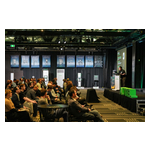
Mr. Raymond, spoke on "Synchronized Global Distribution for the War Fighter...The Way Ahead" at a meeting of the U. S. Army's Military Traffic Management Command's 599th Transportation Group, U.S. Pacific Command. Change is never easy ... I've been through 35 years of change in this business, and the only thing I'm sure of is that it will never stop," he said. "I've watched your progress and you've done things that, frankly, we in the private sector only hope to accomplish as well. I'm talking about streamlining your organization, reducing layers, cutting out costs, and relocating parts of the organization while maintaining a high level of service to your customers. That's like changing the spark plugs while the car is still running down the road."
“Today, moms don't shout when they call the family to dinner ... they instant message everyone. E-mail, on a large scale, didn't exist until the early 1990s. Now, over 600 billion e-mail messages are sent each year. We're drowning in information, but we're thirsty for knowledge, the ultimate competitive advantage”
Mr. Raymond, noting other factors, said "..we're also being driven by the geopolitical changes in our world. The pace of change has never been greater, and continues to grow ... just look at what technology has done to our world in the span of a few decades."
He recalled that during the Viet Nam war, news reporters used film to cover the action, film had to be flown back to New York, developed, and put on the air. "It took three days at best, usually longer, for news and pictures of the war to reach our country. This year," he continued, "we saw fighting live in our living rooms and watched infantry movements over breakfast." The war, he said, "came home."
"Today, moms don't shout when they call the family to dinner ... they instant message everyone. E-mail, on a large scale, didn't exist until the early 1990s. Now, over 600 billion e-mail messages are sent each year. We're drowning in information, but we're thirsty for knowledge, the ultimate competitive advantage," said Raymond.
Recognizing MTMC's efforts - "your personal sacrifices in protecting the freedom of all Americans," Chuck Raymond said: "The work you have done here, supporting operations from Kosovo to Afghanistan to Iraq, as well as our forces around the rest of the world, is simply amazing. Those of us in the business marvel at what you are able to accomplish."
Also crediting the advancement in information technology in perfecting this effort. "I'm especially impressed by your use of technology, things like your online booking initiatives, PowerTrac Payment system, and on the near horizon, the implementation of the incredible STMS (Surface Transportation Management System - projected - May '04). It takes commitment and a real gut-level desire to change, but in the end your customers will be better off. Behind these changes is a new mindset about what you do and why you do it," he continued. "You're not just moving men and materials from Point A to Point B ... you're starting to look at the whole supply chain, managing the entire flow from A to B, and back again, in real time with real information. The Distribution Analysis Center, of course, brings that strategy to life. You're managing your supply chain in a proactive, value-added way that many private sector companies are only beginning to realize is important." He added: "The best advice I can give you, are the three things we work hard on every day at Horizon Lines:
... First, know your customers.
... Second, focus on execution.
... Third, be the smartest fighter on the battlefield."
He spoke to the gathering about how the MTMC effort is also being mirrored today at Horizon Lines, the largest U. S-flag and Jones Act carrier, in its commercial endeavors. "Things are happening faster and faster, and people want it cheaper and cheaper. You're being asked to do it faster, with fewer people, and at less cost, and, in MTMC's case, with more uncertainty about where and how long you'll be asked to support troops." Raymond concluded: "You're no strangers to doing the impossible ... it just keeps getting harder."
Memo editors: The complete text of Mr. Raymond's speech follows.
Photo available upon request. "Synchronized Global Distribution for the Warfighter... The Way Ahead" Military Traffic Management Command's 599th Transportation Group U.S. Pacific Command Honolulu, HI October 22, 2003 Charles A. Raymond CEO, Horizon Lines
I. Introduction
Aloha and good morning, everyone. I'd like to thank you for inviting me to speak to you this morning. Over the years I've talked to many audiences, and when this invitation came to speak to you today in Honolulu, I didn't think twice about joining this first-class group of people in one of my favorite places.
Before we go on, I'd like to extend my personal thanks, as well as the gratitude of everyone at Horizon Lines - and every American, for that matter - for your personal sacrifices in protecting the freedom of all Americans. The work you have done here, supporting operations from Kosovo to Afghanistan to Iraq, as well as our forces around the rest of the world, is simply amazing. Those of us in the business marvel at what you are able to accomplish.
As you know, one of your own, a retired general by the name of Ken Privratsky is now working with me at Horizon Lines. We are thrilled to add his expertise to our company. Let me assure you this old soldier is nowhere close to fading away ... he's stronger than ever. I can guarantee that you will see the fruits of his efforts in making our service to you better than it ever has been.
I understand there's a little golf played on this island... well, Ken told me a story about the first time he played in a business tournament as a civilian. It seems the four-some included two of our major accounts and Lee Trevino. So Ken drives his first tee shot way to the right and it settles in the rough, very near to the water's edge, about 140 yards from the first green. He picks-up his ball, reaches into his bag and drops a rather old ball in its place. Seeing that, Lee comes running across the fairway and says "General, put that ball back in your bag and put that good ball back down there". "Now, let me see you swing an 8-iron" ....... "OK let me see you swing that again"..... And Lee says to Ken: "General, I have one suggestion for you....." Ken asks: "What's that, Lee? With that Lee smiles and says, Ken, stick that good ball back in your bag and put that old water ball back down on the ground"! ........... Ken complains he doesn't get as many "mulligans" these days in civilian golf as he used to get in the Army! ---
This morning, I'll give you a brief overview of Horizon Lines, where we've come from and what we think the future holds for us, and then we'll talk about what it takes to provide world-class service to a world-class organization.
II. Acknowledgement of MTMC's role
But first, I want to give you an outsider's impression of the MTMC. While Ken was in command, he began a number of initiatives that many of you have implemented with tremendous success. Change is never easy ... I've been through 35 years of change in this business, and the only thing I'm sure of is that it will never stop.
I've watched your progress and you've done things that, frankly, we in the private sector only hope to accomplish as well. I'm talking about streamlining your organization, reducing layers, cutting out costs, and relocating parts of the organization while maintaining a high level of service to your customers. That's like changing the spark plugs while the car is still running down the road ... Believe me, we've tried to do the same type of things at Horizon Lines, and we know just how hard it is. My hat is off to you.
I'm especially impressed by your use of technology, things like your online booking initiatives, PowerTrac Payment system, and on the near horizon, the implementation of the incredible STMS (Surface Transportation Management System - projected - May '04). It takes commitment and a real gut-level desire to change, but in the end your customers will be better off. Technology today allows the customer to have so much more control, and allows us to concentrate on what we do best.
Behind these changes is a new mindset about what you do and why you do it. You're not just moving men and materials from Point A to Point B ... you're starting to look at the whole supply chain, managing the entire flow from A to B, and back again, in real time with real information. The Distribution Analysis Center, of course, brings that strategy to life. You're managing your supply chain in a proactive, value-added way that many private sector companies are only beginning to realize is important.
From our point of view at Horizon Lines, we value our relationship with you, and we truly appreciate your efforts at allocating cargo to U.S. Flag carriers ... I realize I'm preaching to the converted here, but the state of the merchant marine in this country continues to be a matter of national security. Your efforts to preserve our merchant marine will pay dividends to you and this country for years to come. The war in Iraq, as well as Desert Storm, once again proved the value of a merchant marine available to our nation in time of conflict. We've learned the same hard lesson over and over and over -- the only people we can truly count on is ourselves, and we desperately need enough American crews at the helm of American ships.
I'll get off my soapbox now ... good thing it's a large box, because I know all of you are with me on this one.
III. Background and update on Horizon Lines
I'll tell you, at Horizon Lines, Hawaii is one of our most important markets for commercial traffic as well as all the freight we move for the Traffic Command.
And it's fitting that you are holding your Pacific Command meetings here in Hawaii. In the mid-late 1800's, brave Americans such as Commodore Matthew Perry, Matthew Maury, Franklyn Buchanan and Nathanial Savoy began to realize the power of Japan. Their population in 1850, 31 million people was larger than that of the United States, at 23 million. They began to realize, for example that Tokyo had become the world's largest and most vibrant city with a population of over one million. (This was at a time when the population of Washington DC was 35,000 and pigs and chickens roamed the streets). Japan was the most urbanized country in the world, with almost 7% of its population living in the cities, compared with 2% in Europe. By many measures Japan had the highest standard of living in the world, with a nationwide system of roads, a national marketing system and majestic cathedrals that exceed the size of their medieval European examples. There were awesome symbols of their prodigious strength. Japan went on to develop a self-conception as a divine, unconquerable land and later, under Emperor Meiji and Hirohito wrecked havoc throughout the Pacific....in China, Korea, the Philippines, Russia and certainly here in Hawaii. Today our country has to focus on more than one strategic threat and we believe there is a very certain and strengthening role this State and its Military support systems will be playing as we move through the next few years of this century.
Horizon Lines began service to Hawaii in 1987, when these trades were part of Sea-Land Service. Today, we offer three fixed-day sailings per week, and continuing service to the five Neighbor Islands. Horizon Lines also of course serves Alaska and Puerto Rico. Overall, we operate 17 ships and six ports: three in Alaska, San Juan, Puerto Rico; Apra, Guam; and Honolulu. Just last month, we added a third crane to the port here, which handles 98 percent of all the goods shipped to the island.
Our headquarters are in Charlotte, and our customer service and technology centers are in Dallas.
Speaking of Sea-Land, I mentioned change earlier ... let me talk to you about some of the changes we've been through in the past few years.
I began my career at Sea-Land, which you know is now Maersk Sea-Land, in 1965. Back in 1999, the only company I ever worked for merged with its biggest rival, and spun off the domestic trades. From 1999 until earlier this year, we operated as CSX Lines, named after our parent company at the time, CSX Corporation.
In February of this year, the Carlyle Group, a fourteen-billion-dollar private equity fund, bought us and we changed our name to Horizon Lines.
It's been a good arrangement for us so far ... we have access to the capital we need, and management input from some very intelligent, experienced people. Of course, it doesn't hurt to have people like Louis Gerstner, formerly of IBM, James Baker, Secretary of State for George Bush and Secretary of the Treasury for Ronald Reagan, and Arthur Leavitt, former chairman of the SEC, helping shape your company and make the connections necessary for us to grow and thrive.
I don't have a crystal ball, so I'll just acknowledge that the Carlyle Group typically buys companies with potential, helps them reach that potential, and then maximizes shareholder return with an eventual favorable exit. So while I can't say when, it is clear that our evolution is far from over. In the meantime, we will take every advantage of the incredibly strong platform the Carlyle Group offers us. We plan to grow, both in our core transportation offerings and our technology and logistics services.
Looking ahead, next year will be an interesting time ... that's when our non-compete agreement with Maersk expires. Then we will be free to enter the international trades, although at this point we don't have definite plans. All I can tell you is that we're looking for opportunities that will match our services and our capabilities. We won't do anything rash, but it is of course a prime opportunity for us to grow. I tell you, I feel like a red-shirt freshman finally getting to play.
Through all the changes, we have nurtured the spirit that made Sea-Land such an exciting company; we continue to be innovative, backed by superior execution, driven by high-quality people. Today Horizon Lines is smaller, more responsive and even more focused on the customer.
I can tell you, all of us take tremendous pride in being an American flag carrier ... In fact, "American Ingenuity" is a key plank of our brand platform, and we truly feel that gives us a competitive edge.
IV. What's on Your Horizon?
As we go forward, one of the things I'm most excited about is our new marketing brand message that issues the challenge: "What's on Your Horizon?"
We know our customers are hungry for visionary logistics partners; people who can make their supply chain a competitive advantage for them, not a cost center. We're showing our customers what's on their horizon ... we try to be out in front of them, looking forward over the horizon, showing them the way. Sometimes, when you're a leader you sneak a quick peek back over your shoulder to see if any one is following. We think they are.
Technology, of course, continues to drive much of the change in our business ... but we're also being driven by the geopolitical changes in our world. The pace of change has never been greater, and continues to grow ... just look at what technology has done to our world in the span of a few decades.
During the Viet Nam war, news reporters used film to cover the fighting. That film had to be flown back to New York, developed, and put on the air. It took three days at best, usually longer, for news of the war to reach our country.
This year, we saw fighting live in our living rooms and watched infantry movements over breakfast. Today, moms don't shout when they call the family to dinner ... they instant message everyone.
Email, on a large scale, didn't exist until the early 1990s. Now, over six hundred billion email messages are sent each year. We're drowning in information, but we're thirsty for knowledge, the ultimate competitive advantage.
Things are happening faster and faster, and people want it cheaper and cheaper. You're being asked to do it faster, with fewer people, and at less cost, with more uncertainty about where and how long you'll be asked to support troops.
You're no strangers to doing the impossible ... it just keeps getting harder.
The best advice I can give you, are the three things we work hard on every day:
-- First, know your customers.
-- Second, focus on execution.
-- Third, be the smartest fighter on the battlefield.
The first one is the easiest, and the hardest. And it's the reason why I'm here today. I'm talking to you right now, but I also plan to do a lot of listening to you, about how we can serve you better. And the trick is to listen so well, you figure out a way to give your customer something they don't even know they want yet. We didn't know we needed a cell phone that can take a picture. But they're here.
I've read reports about the logistics challenges during Desert Storm ... vehicles arrived with flat batteries and with the wrong oil for desert temperatures. We've heard that on average, a combat battalion's equipment was stowed on seven different vessels that took 26 days to reach port in Saudi Arabia. The success you achieved in Iraqi Freedom is a true testament to getting to know your customer.
We start with the customer's end result ... what do they need to be successful? We want to know about our customer's business so we can understand their entire pipeline, not just when it happens to involve our ships. You have to know all the dependencies and responsibilities in an organization to do the job well. We all have intermediate customers created by our relationships ... some of you in the audience are my customers, even though you don't ship with us. But what we do impacts your ability to serve the MTMC.
Start with the battlefield warfighters and their commanding officers ... Ask yourself, what will ensure that they have the right equipment in the right place, at the right time, in go-to-war condition? It's up to you to work with your customer to supply real value to them ... for instance, supply chain visibility is great, but a soldier in a forward area doesn't have the time to check web sites for shipment tracking... It's more important to offer predictability and reliability, so the customer can count on you. That way he doesn't have to watch over every shipment. He has a high degree of confidence in the system and can concentrate on doing his job, not yours.
It's true, customers may not want to let you get that close, but it's vital that you do. Show the value you can bring, so the reward of doing it with you far outweighs the benefits of doing it without you.
One example of knowing what your customer truly needs is our Internet booking. Today, over 70 percent of our customers use our web site to book their cargo and track it. Most other carriers are in the 15 to 17 percent range at best.
We're almost completely paperless for booking, tracking and tracing, invoicing, and automatic email arrival notices to the shippers and/or consignees. This results in our people spending about 90 percent less time on the phone. That efficiency really pays off for us ... when Navieras pulled out of the Puerto Rico market last year, our market share went from 23 percent to 35 percent, but we were able to handle the extra volume in our Dallas processing center without adding any people because our customers were using the web.
At first, it took some convincing to move our customers from phones and faxes to the Internet, but now they wouldn't go back to the old way if even if we offered them the chance.
Our system offers tremendous visibility into what's on the vessel, so our customers can accurately account for shipments in their inventory planning.
If we had surveyed our customers and asked them whether they wanted to book on the Internet, a large part of them would have said "no." But we knew that we could offer so much better service, at a lower cost, if we took this step. We knew our customers well enough to know what they truly needed.
It was our goal to offer real value ... not just tweak the system we had, but offer a whole new way of doing business, based on our understanding of our customers' needs. We staked out a leadership position that was over the horizon line, and our customers responded.
So my advice ... know your customers so well, you know what they want before they want it. That takes a lot of dialogue, listening, and observation, too. Spend time in the field with the people you serve, and make sure your front line people who implement your plans get to see your operation from beginning to end, so they know how their actions impact the entire chain.
That brings me to the second element ... focus on execution. Make sure your staff understands what's critical to your customers' success. Understand your processes, tear them apart and put them back together again. Weed out those things don't truly add value; remove as many bureaucratic steps as you can. Find ways to add value for your customer ... give them information they need before they have to ask for it.
Execution was on everyone's mind during the Tandem Thrust Exercise earlier this year. Our people, including Charlie Battiato and Rick Agustin, worked with the Traffic Command and the 25th Infantry Division to move boxes, flats and military containers from Hawaii to Tinian and back.
Our people did an on-site survey of the cargo, leased equipment and met with everyone to coordinate delivery. Thanks to careful planning, we staged equipment in the port yard on the return trip, instead of lining it up on Route 11 as we had in the past. That made the port and its neighbors happy as well.
We moved the equipment to delivery on the agreed-on date, on one vessel as requested. We also had a few requirements for you, such as securing all loose items, and cleaning the equipment to meet agricultural regulations. It took a lot of coordination and some give and take, but we were able to meet all your requirements.
This is a great example of one of the most beneficial steps... create partnerships with other organizations focused on quality. Doing it right the first time is the most efficient way to operate. Since we've migrated so much of our processing work to the web, we've found that we spend much less time on problem resolution, freeing up our resources for growth rather than fixing what's broken. We call it running to pro forma - run operations to the schedule, doing it right the first time.
You've experienced the same thing ... shipping a battalion to Iraq with all their vehicles, spares and other gear to the right place at the right time puts them in a position to be an effective fighting force that much sooner. Your costs are less, the mission gets accomplished more quickly and your customers are happy.
The customer's battlefield is the place to start ... for you, it was the sands of Baghdad and Tikrit. For us, it's the aisles of Wal-Mart and Costco or behind the counter at McDonalds. Design the supply chain backwards, starting at the end. Support the warfighter on the battlefield first of all. Figure out what they need to be successful. The list is usually short: information, accessibility, and reliability.
Information in the right amount is vital. Customers don't have time to track every step of every shipment. A soldier or airman on the battlefield doesn't have time to dial in to some remote server to find out the status of the shipment. They have to have the confidence in the system that it will work. They like predictability, not surprises. Surprises are the last thing you want in a supply chain, so an exception report or an alert that the shipment is not moving according to plan is more valuable than overloading the customer with routine updates. We're working toward developing proactive alerts to customers when changes or delays occur.
Second, accessibility is key ... most of your customers are thousands of miles and many time zones away. Whenever that kind of physical separation exists, it's important to condense all those time zones into one, the one where your customer is now. Someone needs to be there to answer the phone, send a fax, whatever is necessary to keep things moving. We need to function according to the customer's clock, to be in the same moment as those we support.
Of course, reliability is the name of the game. You walk in a McDonalds, order a quarter-pounder and fries, you know what you're going to get. There's no guess work, no decision making. You get it the same way every time. You tell them what you're going to do; you do it that way, and let them know you did it.
We were named Wal-Mart's carrier of the year last year ... due in large part to our reliability. They carry up to 150,000 different items in their Super Centers, so consistency of execution is critical. War fighters waiting on ammunition and spare parts expect at least the same level of service that Wal-Mart receives.
You'll note that speed is not on the list ... even though there's been talk about faster ships for the Merchant Marine. I can tell you, the delays do not occur on the ocean. Why aren't the skies filled with supersonic airliners? Because crossing the ocean at Mach 2 doesn't help much when it still takes two hours at the airport to even get on the airplane.
Ships can cross the ocean in five to seven days ... but the entire supply chain can be two to three weeks. The problem is not in the speed of the ships, but in the processing and holding areas at either end. It's impossible to build a ship fast enough to cut two weeks off the transit time, or take two weeks out of a bad process. And incremental speed improvements simply don't justify the added costs. It's better to spend the money on removing bottlenecks at the terminals, taking time out of bad processes.
Finally, be the smartest fighter on the battlefield. Technology won't replace a sound strategy or flawless execution. But without the most effective technology, none of those things will even have the chance to become a factor in victory.
The most important lesson about technology, one that I drive home all the time, is this: "Just because you can, doesn't mean you should." There's a lot of technology out there, a lot of razzle dazzle that looks great in your hands. People get pulled in by the next big thing. But it always has to stand up to the ultimate test: does it benefit the customer?
Look for the technology that allows you to do it faster and cheaper. A fancy web site with spinning globes and a hip hop sound track might - might -- be OK on the first visit, but by the second visit the customer wants to get in, do their transactions and get out. We are now trying to drive our customers off the Internet by giving allowing them to customize the alerts and reports they want so they can manage by exception.
Look for technology that allows your customer to do what's important to them - not what's important to you. The future will hold even more interactivity and visibility.
We're making great progress in that direction. For instance, our Auto-Book web tool lets customers automate routine shipments. Shippers receive automatic confirmations with booking numbers and a summary of containers booked. They can make changes to their bookings anytime prior to containers being received. With this tool, our customers are in control. They cut out a lot of repetitive work; we get the bookings with less handling cost.
As you look for that next great technology, be involved. Ask questions; make sure your requirements are being met. It's too important to be left to the propeller heads, the software guys who know their stuff but don't know our business. Look for the technology that breaks through barriers, helps you cut out cost and time. That's where the speed improvements will come from ... we'll never move boxes at the speed of light, but you can rest assured that your business moves that fast.
V. Conclusion
Thank you again for this opportunity ... it's a real treat to spend time with you, and thank you personally for your dedication and sacrifice. As you look toward your horizon, know that Horizon Lines is positioned with quality people, outstanding technology and equipment, all dedicated to helping you overcome any problems that stand in the way of serving your customers better.
As your organizations continue to take on an ever more vital role in supporting U.S. policy around the world, rest assured that Horizon Lines stands with you. We want to help you build a world where everyone's horizon is bright.
Thank you, and Mahalo.